

Introduction: criminology theories
Criminology has never been a discipline built upon a single explanatory key. It is, rather, a field of tension, dialogue, and contestation, where each major theory illuminates one dimension of the criminal phenomenon while leaving others in partial shadow. Crime is at once a legal violation, a social act, a moral rupture, a cultural product, and a response to structure. It is shaped by inequality, by conflict, by frustration, by symbols of status, by institutions, by class, by power, by learning, by community, and by individual interpretation. To understand crime is therefore to confront the entire architecture of society. It requires attention not only to the offender, but to the social order that produces offenders, labels them, excludes them, and often reproduces the conditions of their emergence.
Among the most influential interpreters of crime in modern social thought are Albert K. Cohen, Karl Marx, and Robert K. Merton. Each belongs to a distinct intellectual universe, yet each contributes a profound lens for understanding criminality. Cohen examined delinquency through the prism of status frustration and the formation of subcultures. Marx situated crime within the contradictions of capitalism, class domination, and the legal order of the bourgeois state. Merton, adapting structural functionalism, explained deviance as a consequence of the strain produced by disjunction between culturally prescribed goals and socially distributed means.
Together, these thinkers offer a powerful triangulation. Cohen helps explain the cultural and group-based formation of delinquent behavior, especially among marginalized youth. Marx reveals how law and punishment reflect deeper relations of power and exploitation, and how crime cannot be separated from the economic structure of society. Merton shows how socially organized pressure can generate deviant adaptation when legitimate means are blocked. Their ideas do not simply coexist; they speak to one another across the historical landscape of modern sociology and criminology, sometimes converging, sometimes diverging, and often enriching one another through tension.
This article offers a comprehensive criminological analysis of these three figures. It examines their major works, their central concepts, the way each interprets crime, and the intellectual dialogue their theories create with other major scholars. The aim is not merely to summarize three theories, but to place them within a larger philosophy of social order and deviance. Crime, after all, is not only an act of breaking rules; it is a window into the rules themselves.
I. Albert K. Cohen
1. Intellectual Background and Theoretical Position
Albert K. Cohen occupies a central place in the history of delinquency studies because he shifted attention away from the purely individual offender and toward the social ecology of youth groups, status systems, and cultural adaptation. His most celebrated work, Delinquent Boys: The Culture of the Gang (1955), transformed the study of juvenile delinquency by arguing that many forms of delinquent conduct are not random outbursts of pathology, but collective responses to structural failure and social exclusion. Cohen’s analysis emerged in dialogue with the Chicago School, with Robert K. Merton’s strain theory, and with earlier concerns about anomie, social disorganization, and class-based inequalities in achievement.
Cohen’s genius lies in the fact that he did not reduce delinquency to a simple lack of discipline or to defective personality. Instead, he treated delinquency as a social product, a symbolic formation, and an alternative status system. Young people, especially working-class boys in competitive school environments, confront a world in which the dominant standards of success are defined by middle-class norms: ambition, articulate self-control, delayed gratification, cleanliness, courtesy, rational planning, and academic performance. When boys from subordinate backgrounds repeatedly encounter failure in this system, they may experience what Cohen famously called status frustration. This frustration does not remain passive. It can incubate a counterculture, a collective inversion of values in which the qualities admired by the mainstream are rejected, mocked, or reversed.
2. Status Frustration and the Birth of Delinquent Subculture
Cohen’s notion of status frustration is one of the most important contributions to sociological criminology. It identifies a deeply social wound: the humiliation that follows repeated inability to achieve recognition in a stratified school and class environment. The issue is not only material deprivation, although that matters, but symbolic defeat. Many adolescents are deeply sensitive to rank, approval, dignity, and peer evaluation. When institutions deny them status through conventional routes, they may seek status elsewhere. Delinquency then becomes a strategy of symbolic compensation.
This compensation is collective rather than purely individual. Cohen did not imagine a lonely youth quietly turning to crime in isolation. He imagined a gang, a group, a subculture—a social world that creates its own criteria of respect. Within that world, acts of vandalism, toughness, insolence, cruelty, and rule-breaking may acquire prestige precisely because they defy the school, the neighborhood, the police, and the respectable adult order. The delinquent subculture does not merely reject mainstream values; it constructs a counter-moral universe. Status is obtained through loyalty to the group, willingness to violate norms, and mastery of a shared style of defiance.
3. The Malevolent Middle-Class Measuring Rod
One of Cohen’s most enduring insights is his critique of the middle-class measuring rod. The school system, he argued, tends to evaluate children according to standards that are not neutral or universal, but culturally specific. Middle-class norms are treated as if they were the natural standards of human excellence. Yet these norms reflect a particular social location. Children from working-class backgrounds may be judged inferior not because they lack intelligence or moral worth, but because they have not been socialized into the same behavioral code.
This insight has enormous criminological significance. If the school is one of the first major institutions to define success and failure, then repeated humiliation there can have lasting consequences. Delinquency may then develop as an adaptive protest against a system perceived as unjust. Cohen’s analysis thus links crime to the everyday functioning of institutions, especially those that sort children into categories of success and failure.
At the same time, Cohen’s theory has been debated. Some critics argue that it overemphasizes male working-class delinquency and underestimates female delinquency, white-collar crime, and crimes committed by those who already possess social power. Others point out that not all delinquent youth are status frustrated, and not all frustrated youth become delinquent. Yet these objections do not weaken Cohen’s importance. They simply show that his theory captures one major pathway into delinquency rather than the whole of criminal behavior.
4. Relation to Merton, Sutherland, and the Broader Tradition
Cohen’s work is deeply indebted to Robert K. Merton, whose strain theory supplied the basic insight that cultural goals and legitimate means may be unevenly distributed. But Cohen went further than Merton in one crucial respect: he focused on collective adaptation and the creation of subculture. Where Merton emphasized individual modes of adaptation—conformity, innovation, ritualism, retreatism, rebellion—Cohen examined how a group, particularly a youth group, develops its own shared identity in response to blocked status opportunities.
Cohen also intersects indirectly with Edwin Sutherland’s differential association theory. Delinquency, in both views, is socialized. It is learned, reinforced, and normalized in interaction with others. Yet Cohen adds a structural dimension absent from a purely learning-based account: delinquent association itself may be generated by status failure. Thus the group is not merely a site of learning; it is a historical response to exclusion.
The broader criminological significance of Cohen’s theory lies in its demonstration that crime is not only about choice or pathology. It is about the social production of meaning. Delinquent behavior becomes intelligible when we understand the local moral economy of youth groups, the institutional system that excludes them, and the symbolic rewards of rebellion.
5. Works and Legacy
Cohen’s Delinquent Boys remains his foundational text, but his influence extends far beyond a single book. His ideas shaped subcultural criminology, youth studies, and later work on gangs, school failure, and peer dynamics. Scholars such as Richard Cloward and Lloyd Ohlin expanded on strain and opportunity structures, while later theorists explored how delinquent subcultures vary by neighborhood, race, gender, and institutional context. Cohen’s emphasis on collective adaptation also anticipated later cultural criminology, which pays close attention to identity, performance, and symbolic resistance.
His legacy persists because he identified a durable sociological truth: people rarely become deviant in a social vacuum. They become deviant in relation to standards that are imposed, denied, contested, and reworked. Cohen’s delinquent boy is therefore not merely an offender; he is a social interpreter, responding to a world that has already interpreted him as a failure.
6. Philosophical Meaning of Cohen’s Criminology
At a deeper philosophical level, Cohen invites us to rethink the meaning of justice in modern society. If institutions systematically confer honor upon some and humiliation upon others, then delinquency becomes a distorted language of recognition. It is a rebellion born from the absence of recognition, a moral protest written in broken windows, noisy gangs, and acts of defiance. Cohen’s analysis suggests that crime can be the shadow side of meritocracy, the underside of competitive schooling, and the social echo of exclusion.
This is why his theory remains relevant in debates about inequality, educational stratification, and youth marginalization. Cohen does not romanticize crime, but he does humanize the offender by locating behavior within a system of blocked aspiration and symbolic injury. Crime, in his hands, is not an inexplicable aberration. It is a social answer to social defeat.
Albert Kircidel Cohen’s contribution to criminology represents a decisive shift toward understanding delinquency as a collective and culturally embedded phenomenon. By introducing the concept of status frustration, Cohen demonstrated that juvenile delinquency—particularly among working-class youth—emerges not simply from economic deprivation or individual pathology, but from the failure to achieve recognition within dominant institutional frameworks such as the school. His theory highlights how social structures impose standards that are unevenly accessible, thereby generating frustration that can give rise to alternative systems of meaning and value.
Cohen’s most significant innovation lies in his analysis of delinquent subcultures as collective adaptations to exclusion. Rather than viewing crime as purely instrumental or rational, he shows that much delinquent behavior is expressive, symbolic, and rooted in the search for identity and peer approval. Within these subcultures, norms are inverted, and behaviors condemned by mainstream society become sources of prestige and solidarity. This insight expands criminology beyond utilitarian explanations of crime, revealing the importance of group dynamics, symbolic resistance, and the social construction of deviant identities.

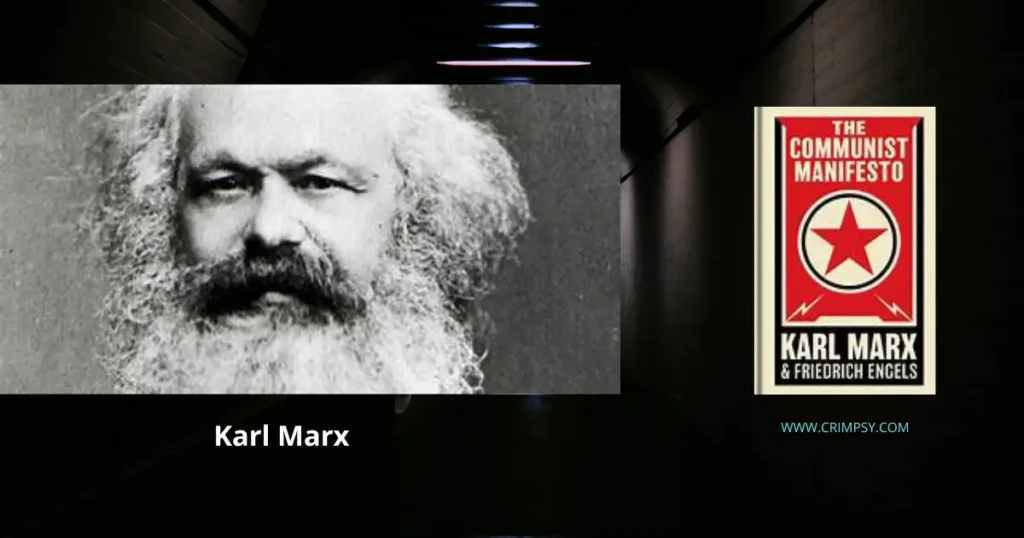
II. Karl Marx
1. Marx and the Foundations of Conflict Criminology
Karl Marx is not usually classified as a criminologist in the narrow academic sense, yet his influence on criminological thought is immense and unavoidable. He did not produce a formal theory of crime comparable to those of later sociologists, but he provided the theoretical architecture for conflict criminology, radical criminology, critical legal studies, and Marxist approaches to deviance. His writings on capitalism, class struggle, labor exploitation, commodity production, ideology, and the state give criminology a fundamentally different way of seeing law and crime.
For Marx, social life is structured by material relations of production. The economic base shapes the legal, political, and ideological superstructure. In capitalist society, the ruling class does not merely dominate through ownership of property; it also defines the norms by which society is governed. Law is therefore not a neutral embodiment of universal justice. It is a historically specific instrument shaped by class interests. This insight has profound implications for criminology. If law is produced within unequal relations of power, then the definition of crime itself is politically loaded. What counts as criminal behavior is not simply discovered; it is constructed and enforced within a class society.
2. Crime, Class, and the Bourgeois State
Marxist criminology begins from the premise that crime cannot be understood apart from class conflict. The bourgeois state creates and maintains legal forms that protect private property, discipline labor, and preserve the conditions of capitalist accumulation. Acts committed by the poor are often more visible and more severely punished than harms committed by corporations, employers, or political elites. Thus the criminal law tends to be applied asymmetrically. The poor thief may be stigmatized, while the exploitative employer remains respectable; the street offender may be incarcerated, while structural violence in the workplace, in housing, or in finance may remain normalized.
Marx does not need to be read as saying that all crime is caused by poverty in a crude mechanical sense. Rather, he encourages a deeper critique: the capitalist order generates social conditions in which some crimes are more visible, while others are concealed beneath legality. He also reveals how legal systems help reproduce domination by presenting themselves as neutral. In this sense, law becomes ideology in action. It claims universality while serving particular interests.
This perspective is essential for understanding white-collar crime, state crime, corporate harm, and the unequal enforcement of criminal justice. A Marxist lens asks not only who breaks the law, but who makes the law, whose interests the law serves, and whose suffering is rendered invisible by legal categories.
3. Alienation, Exploitation, and the Social Roots of Deviance
Marx’s concept of alienation is highly relevant to criminology. Under capitalism, workers are alienated from the product of their labor, from the labor process, from their own human potential, and from one another. This condition produces not only economic hardship, but emotional estrangement and social instability. Crime can be interpreted as one possible expression of a fractured social world in which human beings are treated as instruments rather than ends.
The criminal act may emerge from conditions of desperation, but Marxist analysis goes beyond immediate necessity. It asks why desperation becomes widespread, why communities are destabilized, and why social life is organized in a way that separates people from the fruits of their labor and from meaningful participation in collective life. From this perspective, criminality is not merely a matter of defective individuals. It is related to the contradictions of a mode of production that generates inequality, competition, and recurring crises.
Marxist thinkers after Marx developed these ideas in criminological ways. Willem Bonger argued that capitalist society fosters egoism and competition, thereby weakening social solidarity. Richard Quinney later emphasized that crime is a social reality defined by the state, while Chambliss demonstrated how law itself is shaped by class interests. These scholars did not simply repeat Marx; they translated his critique of political economy into a sociology of crime and punishment.
4. Law as Power and Crime as Social Definition
One of Marx’s greatest contributions to criminology is the recognition that crime is not a natural category. It is a legal and political designation. This does not mean that harm is unreal or that suffering is invented. It means that the boundary between lawful and unlawful conduct is historically produced. Powerful actors often shape this boundary in ways that protect themselves. Crime, in this sense, is not just behavior; it is a social label attached within relations of domination.
This insight later influenced labeling theory, though labeling theorists moved in different directions. Marxist analysis is more structural and more conflict-oriented. It insists that state power determines which behaviors are criminalized and which are excused. For example, forms of labor exploitation may be perfectly legal while minor property offenses by impoverished persons are aggressively prosecuted. The result is a criminal justice system that appears universal while functioning selectively.
5. Marx and the Question of Punishment
Punishment in a Marxist framework is not merely a response to wrongdoing. It is a social practice tied to discipline, labor control, and ideological management. Prisons, for example, may be understood not only as sites of correction but as institutions that manage surplus populations, normalize obedience, and reinforce class hierarchies. The history of punishment is therefore inseparable from the history of labor and the state.
This view has inspired a substantial critical tradition. Some scholars argue that punishment expands in periods of economic insecurity because the state compensates for social inequality through coercive control. Others note that criminal justice often targets populations rendered socially expendable by economic restructuring. The prison becomes, in this reading, a warehouse for the dispossessed, while public discourse frames punishment as moral necessity.
Marx’s influence here is profound because he allows criminology to interpret punishment not as a neutral moral response, but as a historically situated instrument of governance. He reveals that the penal system is part of the same social order that produces inequality in the first place.
Punishment, in this light, can be interpreted as a technology of social regulation that extends beyond retribution or deterrence. It functions to stabilize existing hierarchies by managing populations deemed problematic or surplus. This reframing aligns punishment with broader strategies of governance, suggesting that penal practices are deeply intertwined with economic and political imperatives rather than purely moral considerations.
6. Marx in Conversation with Other Thinkers
Marx’s criminological relevance becomes clearer when compared with other thinkers. Whereas Merton emphasizes the strain created by blocked access to cultural goals, Marx emphasizes the very structure of capitalist society that generates inequality and alienation. Merton’s analysis remains within a functionalist framework, while Marx rejects the assumption that the existing social order is a balanced system. For Marx, social conflict is not a pathology; it is the motor of history.
Compared with Cohen, Marx is more macro-structural. Cohen studies the youth subculture generated by status frustration, while Marx interrogates the class system that forms the broader background of such frustrations. Cohen shows how exclusion produces delinquent culture; Marx asks why exclusion is built into the social order. Thus the two can be read as complementary rather than contradictory.
Marx also resonates with later critical thinkers such as Michel Foucault, who examined the disciplinary power of institutions, and Antonio Gramsci, who developed the notion of hegemony. While Foucault does not share Marx’s economic determinism, both are concerned with the social technologies through which power shapes conduct. Gramsci, meanwhile, helps explain how ruling-class dominance is maintained not only by force but by consent. Together, these perspectives deepen criminology’s understanding of law, punishment, and social control.
The comparative value of Marx lies in his capacity to radicalize otherwise reformist theories. When placed alongside Merton or Cohen, Marx introduces a critical depth that exposes the structural origins of strain and exclusion. This dialogical function enhances theoretical pluralism in criminology, allowing for layered explanations that move from immediate social processes to underlying systems of domination.
7. Works, Ideas, and Enduring Significance
Marx’s major works—The Communist Manifesto, Capital, The German Ideology, The Eighteenth Brumaire of Louis Bonaparte, and A Contribution to the Critique of Political Economy—do not constitute a criminological textbook, but they provide the conceptual foundation for radical approaches to crime. His analysis of class struggle, commodity fetishism, exploitation, and ideology gives scholars the tools to interrogate the social function of law and punishment.
The enduring significance of Marx in criminology lies in his refusal to accept crime as merely an individual failing. He compels us to look upward as well as downward: toward the structures of wealth, power, and authority that shape which harms are visible and which remain normalized. He reminds us that the law often speaks in the language of universality while serving particular class interests.
8. Philosophical Meaning of Marx’s Criminology
At a philosophical level, Marx transforms criminology into social critique. He asks not simply why some people break rules, but why rules exist in their present form, who benefits from them, and how social inequality becomes naturalized through law. Crime is thus inseparable from the moral economy of capitalism. A society organized around exploitation will inevitably produce both social deviance and moral contradictions.
Marx’s vision is unsettling because it exposes the hidden violence of legality. It suggests that the line between lawfulness and criminality is often drawn by the powerful. Yet this very unsettling quality makes Marx indispensable. He forces criminology to confront the political nature of its own categories and to see crime as one expression of deeper social antagonisms.
Marx’s framework compels criminology to adopt a critical stance toward its own categories and assumptions. Rather than treating crime as an objective phenomenon, Marx invites us to question the processes through which certain behaviors are criminalized while others are normalized. This critical reflexivity transforms criminology into a discipline that not only studies crime, but interrogates the social conditions that define and produce it.
In addition, Marx introduces a historical dimension that is often absent in conventional criminological theories. Crime and punishment are not static realities; they evolve alongside transformations in modes of production and class relations. What is considered criminal in one historical period may be tolerated or even institutionalized in another. This temporal perspective highlights the necessity of understanding crime as a historical phenomenon linked to the economic structure, rather than as a fixed or universal reality.Marx’s contribution lies in transforming the ontology of crime itself. He shifts the analytical focus from behavior to structure, from individual culpability to systemic production. Crime, in this framework, is no longer an isolated deviation but a relational phenomenon embedded in material inequalities. This ontological shift compels criminology to interrogate its own assumptions, particularly the taken-for-granted neutrality of law and the ideological function of legal categories.
Finally, Marx’s analysis opens the door to a global understanding of crime. In the era of globalization, relations of exploitation are no longer confined within the boundaries of the nation-state, but have become transnational in scope. This raises new criminological questions about transnational corporations, global inequality, and systemic harms that escape traditional legal frameworks. Marx’s legacy thus remains crucial for expanding criminology beyond the limits of national legal systems toward a more comprehensive and critical analysis.
III. Robert K. Merton
1. Merton’s Place in Criminological Thought
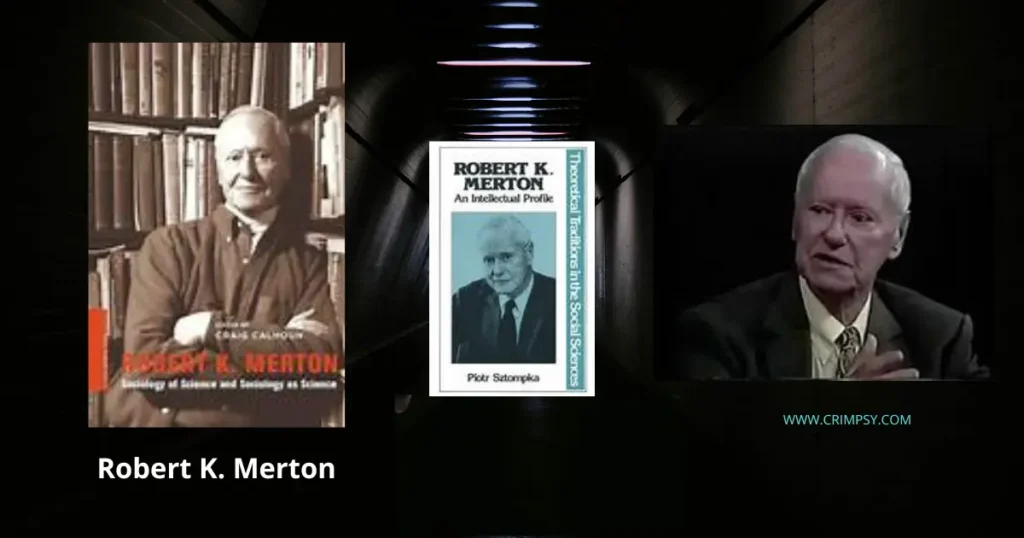
Robert K. Merton stands as one of the foundational figures of sociological criminology, especially through his theory of strain and his broader contribution to structural functionalism. His work does not merely explain deviance; it explains how society itself generates deviant adaptations when its cultural aspirations are not matched by legitimate opportunities. In this way, Merton bridges the gap between social structure and individual conduct.
His classic essay “Social Structure and Anomie” introduced a highly influential framework. Society, Merton argued, establishes culturally approved goals—most notably material success—and simultaneously regulates the legitimate means to achieve them. When a gap emerges between the two, individuals experience strain. Different groups respond differently, producing various forms of adaptation. Some conform, some innovate, some retreat, some ritualize, and some rebel. Crime emerges particularly through innovation, when people accept the goals of success but reject the legitimate means because those means are inaccessible or inadequate.
Merton’s theory is elegant because it preserves both structure and agency. It does not deny human choice, but it insists that choice is patterned by opportunity and constraint. Criminal behavior is therefore not random. It is socially structured deviation.
2. Anomie, Strain, and Innovation
Merton adapted the concept of anomie from Durkheim but gave it a distinct American sociological meaning. For Durkheim, anomie referred to normlessness or moral deregulation. Merton retained the sense of disjunction but focused specifically on the mismatch between cultural goals and institutional means. In a society that glorifies success while limiting access to education, jobs, wealth, and prestige, strain becomes endemic.
This strain does not affect all groups equally. The socially privileged are better positioned to pursue goals through legitimate pathways, while the disadvantaged may find themselves blocked. Under such conditions, some individuals turn to innovation, which may include theft, fraud, drug dealing, or other forms of illicit adaptation. Others may retreat into addiction, escapism, or social withdrawal. The brilliance of Merton’s model is that it explains not only crime, but a range of deviant responses to structural pressure.
Merton thus offers a theory of crime rooted in social organization. Crime is not simply a matter of broken character. It is a response to contradictory social expectations. Society tells people to succeed, but it does not equally equip them to do so.
3. The Five Modes of Adaptation
Merton’s five modes of adaptation remain one of the most famous classifications in criminology and sociology. Conformity accepts both goals and means. Innovation accepts goals but rejects legitimate means. Ritualism rejects the goals while rigidly adhering to the means. Retreatism rejects both goals and means, withdrawing from the social competition. Rebellion rejects existing goals and means and seeks to replace them with new ones.
From a criminological standpoint, innovation is the most directly relevant. Yet the other modes matter because they reveal the broader social consequences of strain. Deviance is not a single behavior but a spectrum of adaptive responses. Some people commit crimes to obtain culturally approved success symbols. Others retreat from the game entirely. Others adopt rigid, bureaucratic compliance without belief. The social system thus produces diverse forms of adaptation according to opportunity and pressure.
This framework was immensely influential because it connected deviance to inequality without reducing it to poverty alone. It also helped later theorists study gangs, white-collar crime, substance abuse, and subcultural responses to blocked mobility.
4. Merton, Cohen, and the Growth of Strain Theory
Merton’s impact on Albert Cohen is direct and profound. Cohen took Merton’s insight about blocked opportunities and adapted it to the cultural world of adolescents. Where Merton analyzed general social strain, Cohen focused on status frustration among working-class boys in schools and peer groups. Cohen’s delinquent subculture theory can therefore be read as an extension of strain theory into the domain of youth culture.
Other theorists extended Merton in different directions. Cloward and Ohlin argued that illegitimate opportunities are also unequally distributed, meaning that access to criminal subcultures depends on local opportunity structures. Robert Agnew later developed general strain theory, broadening strain beyond the goal-means gap to include negative relationships, injustice, and loss. These developments reveal the enduring vitality of Merton’s original insight: strain is socially produced, and deviance is often an adaptation to patterned blockage.
Merton’s theory also invites dialogue with Marx. Both thinkers analyze structural inequality, but Merton remains more reformist and more functionally balanced. Marx sees class conflict as intrinsic to capitalist society, while Merton focuses on social disjunction within a broadly accepted system of cultural aspirations. Marx asks how domination is built into the structure of society; Merton asks how that structure generates deviance when expectations and opportunities diverge. The two perspectives can be combined, but they are not identical.
The evolution of strain theory demonstrates its theoretical elasticity. By incorporating cultural, emotional, and opportunity-based variables, later scholars have expanded Merton’s original model without abandoning its core logic. This adaptability explains the theory’s longevity and its continued relevance in diverse criminological contexts.
5. Merton and the American Dream
Perhaps Merton’s most enduring cultural insight concerns the American Dream. The dream promises success, mobility, and upward advancement. Yet its promise becomes criminogenic when success is glorified more than the means of achieving it. When people are told that achievement is the measure of worth, and when legitimate avenues are insufficient or unevenly distributed, strain intensifies. Crime may then appear as a practical adaptation to a moral demand that society itself has made impossible to fulfill fairly.
This is not simply a matter of individual greed. Merton understands that modern societies create powerful cultural pressure. Success becomes a collective obsession. In such an environment, deviance is not foreign to social order; it is one of its predictable byproducts. The criminal may be an overconformist to the goal of success and an underconformist to the means of legality.
The elegance of this insight explains why Merton remains central to criminology. He captures the paradox of a society that proclaims universal opportunity while reproducing unequal access to that opportunity.
The American Dream, in Merton’s analysis, operates as a cultural engine that simultaneously motivates and destabilizes. Its universal promise masks structural inequalities, thereby intensifying strain. This paradox highlights the criminogenic potential of cultural ideals when they are decoupled from equitable access to resources.
6. Critiques and Refinements
Like all major theories, Merton’s strain theory has faced criticism. Some argue that it overemphasizes utilitarian motives and neglects expressive, symbolic, and emotional dimensions of crime. Others note that not all crime is goal-oriented economic innovation. Violence, vandalism, and many forms of deviance may not fit neatly into the strain model. Critics also point out that Merton’s framework initially paid limited attention to race, gender, neighborhood ecology, and institutional racism.
Yet these critiques do not erase Merton’s importance. They show only that his model is foundational rather than exhaustive. Later theorists refined strain by incorporating relative deprivation, interpersonal conflict, blocked identity needs, and cumulative disadvantage. Even when expanded, however, the basic logic remains Mertonian: structure matters because it shapes the route from aspiration to behavior.
7. Merton in Conversation with Other Theorists
Merton’s work is especially fruitful when placed beside Cohen, Marx, and Durkheim. From Durkheim he inherits the idea that social order is normatively organized and that deviance reflects broader social conditions. From Marx he indirectly inherits the sensitivity to inequality, though without Marx’s revolutionary critique of capitalism. From Cohen he receives a more cultural and group-based elaboration of strain. From later theorists, he receives empirical confirmation and theoretical revision.
Merton’s place in criminology is thus one of mediation. He translates macro-social inequality into a sociological account of adaptation. He shows how criminal behavior can emerge not from evil in the abstract, but from the social arrangement of goals and means. This makes his theory unusually durable across changing historical contexts.
8. Philosophical Meaning of Merton’s Criminology
Merton’s criminology carries a subtle philosophical message: society is never innocent in the making of deviance. Whenever a culture glorifies success more intensely than it democratizes opportunity, it creates conditions in which rule-breaking becomes understandable, even predictable. This does not excuse crime, but it explains it as a social consequence rather than a metaphysical mystery.
Merton also deepens criminology’s moral complexity. He invites us to see deviance not as the opposite of social order, but as a product of its contradictions. Crime is born where aspiration meets blockage. It is the tension between the promise of success and the reality of exclusion. In this sense, Merton’s theory remains one of the most lucid accounts of how social structure becomes conduct.
Philosophically, Merton reveals the ethical tension inherent in modern societies: the simultaneous promotion of universal ambition and the unequal distribution of opportunity. This tension generates a moral ambiguity in which deviance becomes both condemnable and understandable. Crime, in this sense, reflects not only individual failure but structural contradiction.
Robert K. Merton’s contribution to criminology remains one of the most enduring and structurally insightful frameworks for understanding deviance. By linking individual behavior to broader social arrangements, Merton demonstrated that crime is not merely the product of personal failure or moral weakness, but a patterned response to the disjunction between culturally prescribed goals and institutionally available means. His strain theory, rooted in the concept of anomie, provides a powerful explanation of how social inequality and unequal access to opportunity generate systematic pressures that shape human action.
What distinguishes Merton’s perspective is its ability to account for a wide spectrum of adaptive behaviors through his five modes of adaptation, particularly innovation as a key pathway to criminal activity. Rather than isolating crime as an abnormal phenomenon, Merton situates it within the normal functioning of society itself. His analysis reveals that deviance is often a logical, even predictable, outcome of structural contradictions—especially in societies that strongly emphasize success while failing to ensure equitable access to legitimate means of achieving it.
Ultimately, Merton’s work carries profound theoretical and philosophical implications. It challenges the assumption that social order and deviance are opposites, instead presenting them as deeply interconnected. Crime, in this view, emerges from the very values that societies promote, particularly when aspiration is universalized but opportunity is not. This enduring insight explains why Merton continues to influence modern criminological thought and why his theory remains essential for analyzing crime in contemporary contexts marked by inequality, ambition, and structural imbalance.
Conclusion: Causes of crime
Albert K. Cohen, Karl Marx, and Robert K. Merton each illuminate a different level of the criminological imagination. Cohen explains how exclusion from status systems can produce delinquent subcultures among youth. Marx reveals how law, punishment, and criminal categories are embedded in class relations and the capitalist state. Merton shows how structural strain arises when cultural goals are disconnected from legitimate means, producing innovation and other forms of deviant adaptation.
Their theories are distinct, but they are not isolated islands. Cohen extends Merton into the realm of youth culture; Marx deepens the critique of power and inequality that Merton only partly addresses; Merton provides a structural basis that helps make sense of Cohen’s status frustration and Marx’s class conflict. Together, they form a rich conceptual triangle for the study of crime.
The criminological significance of these thinkers lies not only in what they explain, but in how they transform the question of crime itself. Crime is no longer merely an act committed by a deviant individual. It is a social expression of blocked opportunities, institutional exclusion, class domination, symbolic humiliation, and contradictory social expectations. In this sense, criminology becomes a way of reading society as much as a way of studying offenders.
A serious criminological analysis must therefore remain plural. It must ask how structures produce strain, how power shapes law, how groups create countercultures, and how social meaning turns behavior into crime. Cohen, Marx, and Merton do not exhaust the field, but they define three of its most enduring intellectual horizons. Their work reminds us that to understand crime is to understand society itself.
References
Cohen, A. K. (1955). Delinquent Boys: The Culture of the Gang. New York: Free Press.
Marx, K., & Engels, F. (1848). The Communist Manifesto.
Cohen, A. K. (1966). Deviance and Control. Englewood Cliffs, NJ: Prentice-Hall
Merton, R. K. (1968). Social Theory and Social Structure.
Marx, K. (1867). Capital: Volume I.
Merton, R. K. (1938). Social Structure and Anomie. American Sociological Review, 3(5), 672–682.
Durkheim, E. (1897). Suicide.
Crime as a Social, Psychological, and Legal Phenomenon