
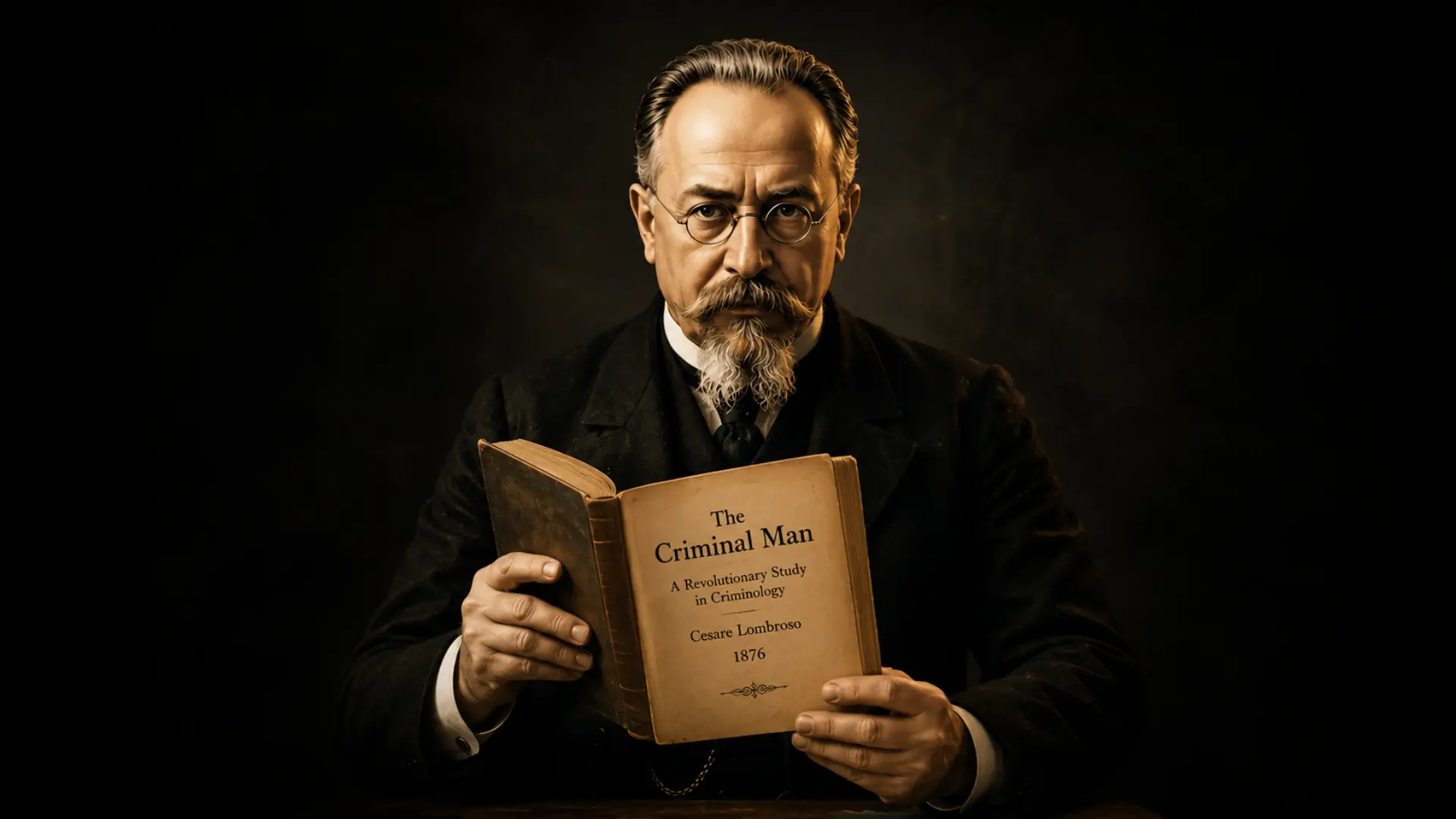
In the dark corridors of the nineteenth century, where prisons echoed with silence and courtrooms carried the weight of human judgment, a revolutionary mind emerged to challenge everything the world believed about crime. That mind belonged to Cesare Lombroso — the controversial pioneer whose ideas would forever transform the foundations of criminology.
What turns an ordinary human being into a criminal?
Is violence a choice, a destiny, or a hidden mark written within human nature itself?
Can science uncover the secrets buried behind the eyes of a murderer?
And is it possible that the roots of crime exist long before the crime is ever committed?
These unsettling questions became the heart of The Criminal Man, a groundbreaking work that shattered traditional theories of justice and introduced a bold scientific approach to understanding criminal behavior. Rather than viewing crime solely as a moral failure, Lombroso dared to examine the biological and psychological dimensions of the criminal mind, opening a new era in the study of human deviance.
At a time when society saw criminals merely as sinners who consciously chose evil, Cesare Lombroso stepped into forbidden intellectual territory. He proposed the shocking theory that some individuals might possess inherited or innate characteristics linked to criminality itself. His theories sparked fierce debates across Europe and beyond, dividing scholars, philosophers, and legal thinkers — yet his influence became impossible to ignore.
The Life and Work of Cesare Lombroso
Cesare Lombroso was born in Verona, Italy, in 1835. A physician and anthropologist, Lombroso’s interest in criminal behavior began during his time working in asylums and prisons, where he observed the physical characteristics of inmates. His medical background allowed him to approach criminology from a scientific perspective, applying empirical methods to study crime.
Few thinkers in the history of criminology have transformed the field as profoundly as Cesare Lombroso. Before Lombroso, crime was largely interpreted through moral philosophy and legal doctrine, where offenders were viewed simply as rational individuals making immoral choices. Lombroso revolutionized this perspective by insisting that crime should be studied scientifically through observation, anatomy, psychology, and empirical investigation. This intellectual transformation earned him the enduring reputation as the spiritual founder of modern criminology and the central architect of positivist criminal science.
Lombroso’s greatness did not lie solely in his controversial conclusions, but in his methodological courage to treat criminal behavior as a subject worthy of scientific analysis. He introduced anthropometry, clinical observation, prison studies, and comparative analysis into criminological research at a time when such methods were revolutionary. His determination to examine the offender rather than merely the offense created an entirely new direction for criminological inquiry and permanently altered the academic study of crime.
The Concept of The Criminal Man
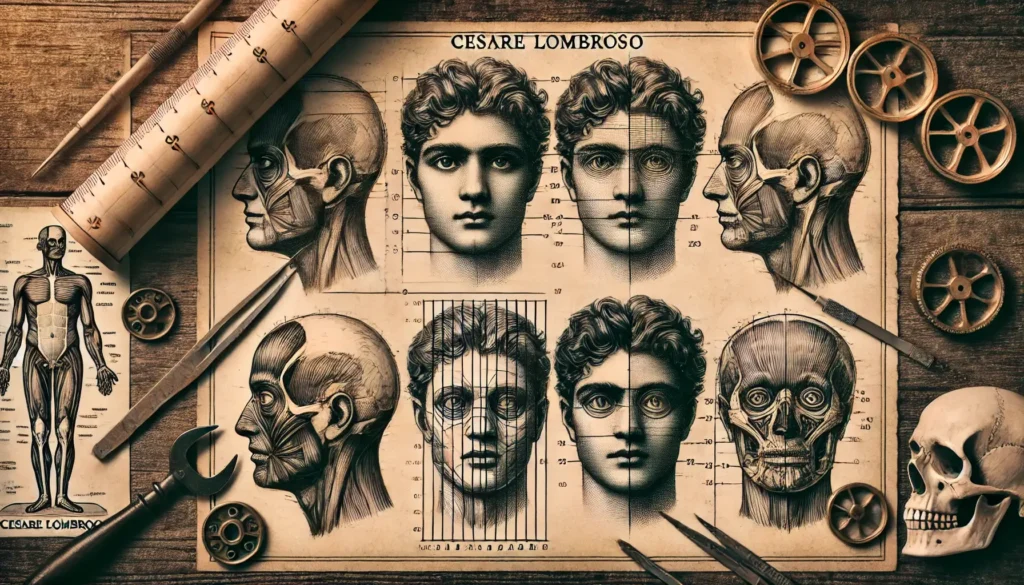
In The Criminal Man, Lombroso proposed that criminals are born with innate traits that predispose them to criminal behavior. He identified these traits through extensive anthropometric measurements and comparative analysis between criminals and non-criminals. According to Lombroso, certain physical features, such as asymmetrical faces, large jaws, and pronounced brow ridges, were indicators of a “born criminal.”
Atavism and Biological Determinism
Through years of field observations, anatomical examinations, and prison studies, Cesare Lombroso argued that certain offenders shared recurring physical characteristics which distinguished them from ordinary individuals. He identified what he called “atavistic stigmata,” a collection of anatomical signs that, in his view, reflected an inherited criminal disposition. Among the most prominent features he described were protruding jaws, Prominent jaws, large ears, a forehead sloping forward, a flat nose, broad shoulders, and long hands compared to the body.
Lombroso also observed that many offenders displayed physical strength, unusual agility, elongated hands, prominent cheekbones, and irregular cranial formations. According to his criminological interpretation, these anatomical traits were not random abnormalities but visible manifestations of a primitive human constitution that resisted social adaptation and moral discipline. His extensive anthropometric studies led him to conclude that the criminal represented a distinct human type characterized by impulsiveness, aggression, and diminished moral sensitivity. Although later criminology moved beyond strict biological determinism, Lombroso’s meticulous observational methods and his attempt to classify criminal behavior scientifically established the foundation of criminal anthropology and secured his place as the pioneering father of modern criminology.
Classification of Criminals
Lombroso categorized criminals into different types:
Born Criminals: Individuals with innate biological defects.
Example:
A violent serial murderer who repeatedly commits homicide without remorse or emotional attachment would, in Lombroso’s view, represent the purest form of the “born criminal.” He also associated this category with individuals involved in brutal assaults, armed robbery, and persistent violent offenses.
Criminals by Passion: Those driven by strong emotions or moral outrage.
Example:
A husband who kills his wife’s lover after discovering betrayal in a moment of uncontrollable rage would be classified as a “criminal by passion.” Lombroso believed these offenders were often emotionally sensitive individuals who later experienced guilt, remorse, or even suicidal thoughts after committing the crime.
Habitual Criminals: People who become criminals due to environmental factors and repeated offenses.
Example:
A young individual who begins with petty theft during adolescence and later evolves into a professional burglar or gang member due to constant exposure to criminal environments would fit Lombroso’s description of the habitual criminal.
Occasional Criminals: Individuals who commit crimes under specific circumstances.
Example:
A financially desperate employee who steals money once to pay for emergency medical treatment for a family member would be considered an occasional criminal. Lombroso believed such offenders were not naturally dangerous but were pushed into crime by circumstances.
Impact on Criminology
Lombroso’s work laid the foundation for the positivist school of criminology, emphasizing scientific observation and empirical data. His theories influenced criminal profiling, forensic science, and even legal practices, shifting the focus from moral judgment to understanding the root causes of criminal behavior.
Cesare Lombroso’s contribution to criminology extended far beyond the boundaries of nineteenth-century criminal anthropology. He fundamentally transformed the study of crime by introducing scientific methodology into a field that had previously been dominated by moral philosophy and legal speculation. Through observation, anatomical analysis, and empirical investigation, Lombroso established the intellectual foundations of modern criminology and inspired generations of scholars to examine criminal behavior through measurable and observable evidence. His pioneering vision elevated criminology into an independent scientific discipline concerned with understanding the offender as much as the offense itself.
Criticism and Controversy
While Lombroso’s theories were revolutionary, they also faced significant criticism:
- Ethical Concerns: The deterministic view ignored social, psychological, and environmental factors.
- Scientific Validity: Modern genetics and psychology have debunked the notion of “born criminals.”
- Racism and Bias: Lombroso’s work has been criticized for reinforcing stereotypes and biases, particularly regarding race and class.
Despite Lombroso’s enormous intellectual influence, his theories generated intense criticism from sociologists, psychologists, and later criminologists who argued that criminal behavior could not be reduced solely to biological abnormalities. Critics maintained that Lombroso underestimated the powerful role of poverty, family instability, unemployment, social inequality, and urban conditions in shaping criminal conduct. Scholars associated with sociological criminology, particularly those influenced by Émile Durkheim and the Chicago School, argued that crime was deeply connected to social disorganization and environmental pressures rather than inherited physical traits.
Legacy of The Criminal Man
Despite the controversies, Lombroso’s contribution to criminology is undeniable. He sparked debates that led to more comprehensive studies of criminal behavior, incorporating sociology, psychology, and environmental sciences. Today, criminology recognizes the complexity of criminal behavior, moving beyond biological determinism to a multifaceted approach.
The enduring legacy of The Criminal Man lies in its revolutionary attempt to explain crime through science rather than moral condemnation. Lombroso was among the first scholars to argue that criminals should be studied objectively as human subjects shaped by biological and psychological forces. This idea fundamentally transformed how societies understood deviance, punishment, and social control.
Lombroso’s influence also transcended criminology and extended into psychiatry, forensic medicine, sociology, and anthropology. His interdisciplinary approach inspired future generations of scholars to investigate the relationship between the human body, the mind, and antisocial behavior. Even modern neuroscientific studies examining aggression, impulsivity, and genetic predispositions echo Lombroso’s original desire to uncover the hidden mechanisms behind criminal conduct.
Perhaps the greatest testament to Lombroso’s historical importance is the fact that his ideas continue to provoke debate more than a century after his death. Few criminologists have left such a profound intellectual imprint on the development of criminal science. Although many aspects of his theory have been criticized or revised, Cesare Lombroso remains an iconic and foundational figure whose contributions shaped the birth of modern criminology itself.
Influence of Lombroso on the Positivist School
Lombroso’s work was instrumental in shaping the Positivist School of Criminology, which sought to understand crime through scientific methods. This school emphasized the study of measurable traits and observable behaviors to uncover the roots of deviance. Unlike classical theorists who focused on free will and moral responsibility, positivists like Lombroso aimed to identify patterns and predict criminal tendencies using empirical data.
This shift towards positivism led to the development of various tools in forensic science, including early attempts at criminal profiling and biometric analysis. Lombroso’s emphasis on objectivity and evidence-based research encouraged the establishment of criminology as a legitimate academic and scientific field.
Lombroso’s influence on the Positivist School cannot be overstated. Together with Enrico Ferri and Raffaele Garofalo, he formed what many scholars consider the first true scientific movement in criminology. While Ferri emphasized social conditions and Garofalo focused on moral abnormalities, Lombroso provided the biological and anthropological foundations upon which the entire positivist movement was constructed. Without Lombroso’s pioneering vision, positivist criminology may never have emerged as a dominant intellectual force in the late nineteenth century.
His theories represented a direct challenge to classical criminology, particularly the ideas of Cesare Beccaria, which focused on rational choice and free will. Lombroso shifted attention away from abstract legal philosophy toward empirical investigation and measurable evidence. This transition marked one of the most important paradigm shifts in the history of criminological thought, establishing criminology as a scientific discipline rather than merely a branch of law or moral philosophy.
Even contemporary criminologists who reject Lombroso’s conclusions often acknowledge the historical brilliance of his scientific ambition. His insistence on collecting data, observing behavioral patterns, and classifying offenders according to identifiable characteristics introduced a new research culture that continues to influence criminological methodology today. Lombroso’s intellectual legacy therefore extends far beyond his biological theories; it resides in the very scientific spirit of modern criminology itself.
Lombroso’s Influence on Criminal Profiling and Policing
One of the practical applications of Lombroso’s theories was in the early development of criminal profiling. By categorizing individuals based on physical traits and behavioral patterns, law enforcement began to create typologies of criminals. This rudimentary form of profiling, although flawed by modern standards, laid the groundwork for more advanced behavioral science approaches used today by agencies such as the FBI.
Additionally, Lombroso’s biological theories informed policing strategies that focused on surveillance and identification of “dangerous” individuals, especially in urban centers. His work influenced how suspects were evaluated, often prioritizing physical appearance as a marker of criminal potential.
Lombroso’s theories also contributed indirectly to the development of modern risk assessment strategies in criminal justice systems. Although contemporary profiling no longer depends on facial characteristics or skull measurements, law enforcement agencies continue to analyze behavioral patterns, psychological indicators, and statistical probabilities when evaluating criminal threats. The evolution from physical profiling to behavioral science demonstrates how criminology gradually moved away from biological determinism toward evidence-based psychological analysis.
Moreover, Lombroso’s emphasis on identifying dangerous individuals influenced debates about preventive policing and state surveillance. Critics warn that predictive approaches can reproduce discrimination if they rely excessively on stereotypes or biased data, echoing many of the ethical concerns originally associated with Lombroso’s theories.
Contributions to Prison Reform and Penal Policy
Lombroso’s classification of criminals also sparked discussions about the purpose of punishment. His work suggested that not all criminals were the same and, therefore, should not be treated equally by the justice system. This idea led to calls for more personalized sentencing and the consideration of rehabilitation for certain types of offenders, particularly “criminals by passion” and “occasional criminals.”
Prison reform advocates built on this notion by pushing for humane treatment, psychological assessments, and the establishment of correctional programs aimed at reintegration rather than mere punishment.
Women and the Theories of Cesare Lombroso
A lesser-known aspect of Lombroso’s work was his views on female criminality. In The Female Offender (1895), he argued that women were less evolved than men and therefore less prone to crime, except in cases where they exhibited “masculine” traits. These claims were based on biased interpretations of biological data and reflected the prevailing gender norms of the time.
Modern feminist criminology has heavily critiqued Lombroso’s portrayal of women, emphasizing the need to understand female criminal behavior through the lens of social inequality, power structures, and gender-specific experiences affecting both men and women in criminology.

Conclusion
The Criminal Man remains a landmark in the history of criminology. Cesare Lombroso‘s attempt to apply scientific methods to the study of crime marked the beginning of criminology as an academic discipline. While his theories are outdated, they paved the way for modern criminological research, emphasizing the importance of empirical evidence and the need to understand crime from multiple perspectives.
Frequently Asked Questions (FAQ)
Who was Cesare Lombroso?
Cesare Lombroso was an Italian physician, anthropologist, and criminologist widely regarded as one of the founding figures of modern criminology. He became famous for introducing scientific and biological approaches to the study of criminal behavior during the nineteenth century.
What did Lombroso mean by the “born criminal”?
Lombroso argued that some criminals were biologically predisposed to crime due to inherited or primitive traits. He believed these individuals displayed physical characteristics such as asymmetrical faces, prominent jaws, unusual skull formations, and other anatomical features that distinguished them from non-criminals.
What is the Positivist School of Criminology?
The Positivist School emphasizes scientific methods, observation, and empirical evidence in understanding criminal behavior. Unlike classical criminology, which focused on free will and punishment, positivism sought to identify the social, psychological, and biological causes of crime.
Did Lombroso influence criminal profiling?
Yes. Although his methods are considered outdated today, Lombroso’s attempts to classify offenders according to observable characteristics contributed to the early foundations of criminal profiling and behavioral analysis.
What is Lombroso’s legacy today?
Despite criticism, Cesare Lombroso remains one of the most influential figures in the history of criminology. His work sparked major debates that eventually led to more advanced studies in sociology, psychology, neuroscience, and criminal justice.
Academic References
Books
- The Criminal Man — Cesare Lombroso
- Criminal Man According to the Classification of Cesare Lombroso — Cesare Lombroso
- The Female Offender — Cesare Lombroso and Guglielmo Ferrero
- Principles of Criminology — Edwin Sutherland
- Criminology — Larry Siegel
- The New Criminology — Ian Taylor, Paul Walton, and Jock Young
- Theories of Criminology: Understanding Crime and Society
- Born Criminal Theory by Cesare Lombroso
- Basics of Criminology: An Introduction for Students and Researchers