
Criminal psychology is a precise branch of psychology, not limited to merely studying crime as an act contrary to the law, but it seeks to penetrate the depths of the human psyche to understand the internal structure that produces this act. From the perspective of this science, crime is not a random incident or a momentary decision; rather, it is the result of a long psychological trajectory in which desires, conflicts, pressures, upbringing, and personal experiences intertwine. Hence, understanding criminal behavior requires moving beyond superficial legal explanations toward deep philosophical psychological analysis.
The transformations witnessed by modern societies—from the complexity of social relationships to the disintegration of family bonds and increasing economic pressures—have made the phenomenon of crime more ambiguous and intricate. Crime can no longer be explained solely through the concepts of deterrence and punishment; it has become necessary to investigate the underlying psychological motives. Here emerges the pivotal role of criminal psychology, which attempts to answer fundamental questions: Why does a person commit a crime? Is a person born a criminal, or do they become one? And can they be reformed?
Many thinkers have contributed to the development of this field, including Sigmund Freud, who revolutionized the understanding of the human psyche by revealing the existence of an unconscious world that guides human behavior. Albert Bandura also contributed by interpreting crime through social learning, while Erich Fromm linked crime to human alienation. These different approaches reflect the richness and complexity of this science and confirm that crime is not a simple phenomenon but a reflection of human nature itself.
To what extent can crime be explained as a direct result of an individual’s psychological structure?
First: The Concept of Criminal Psychology
It is a specialized branch of psychology that focuses on the study of criminal behavior. It seeks to understand the internal motivations, mental processes, and personality traits that drive an individual to commit a crime. This field is not limited to merely describing crime; rather, it analyzes:
- How does the criminal think?
- Why does an individual decide to commit a crime?
- What psychological factors (such as trauma, emotion, disorders, or upbringing) influence them?
From a philosophical perspective, criminal psychology seeks to deconstruct the relationship between freedom and compulsion within the human psyche. Does a person choose crime with free will, or are they driven by internal forces beyond their control? This question resonates in Sigmund Freud’s works, who argued that humans are not entirely masters of themselves but are governed by unconscious forces.
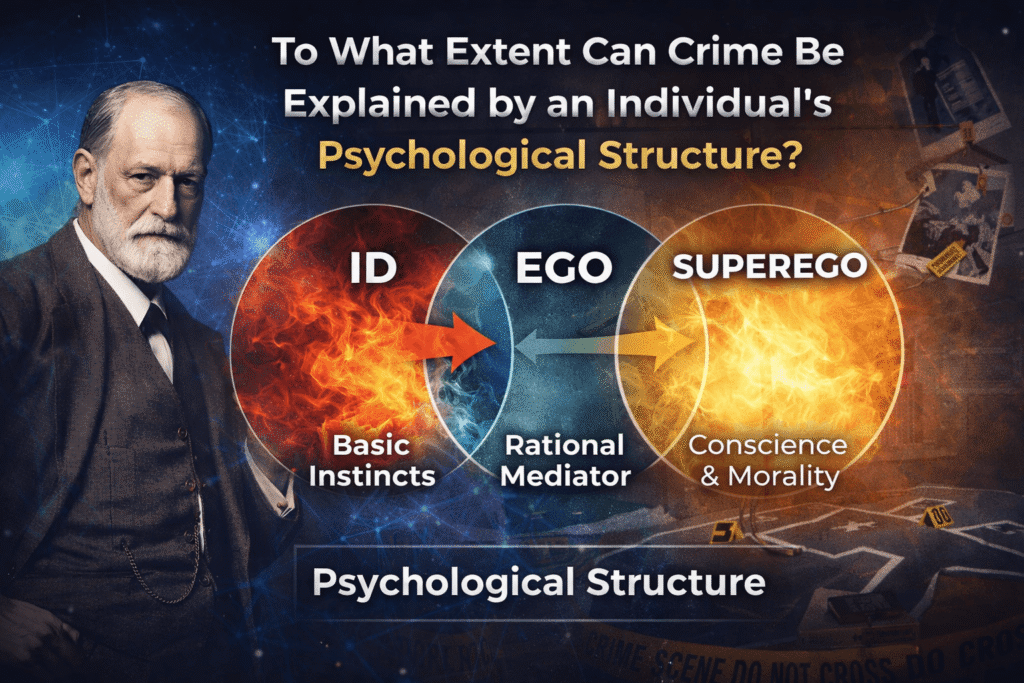
Freud proposed a tripartite model of the human psyche, consisting of the Id, the Ego, and the Superego—a model crucial for understanding criminal behavior:
- Id: Represents the primitive aspect of the psyche, a repository of instincts and innate desires, such as aggression and sexuality. It operates according to the pleasure principle, seeking immediate gratification without regard for values or laws. In the criminal context, crime can be seen as the triumph of the Id when aggressive desires are freed from any constraint.
- Ego: Represents the rational, realistic aspect, acting as a mediator between the Id and the external world. It functions according to the reality principle, attempting to satisfy the Id’s desires in a socially acceptable way. However, when the Ego is weak, it fails to control the Id, potentially leading to criminal behavior.
- Superego: Represents the conscience and moral values acquired from society. It prevents a person from committing deviant acts. When this part is weak or distorted, the individual becomes more prone to deviance.
The conflict among these three components forms the core of human behavior, including criminal behavior. From this perspective, crime is merely the result of an imbalance in this psychological equilibrium.
While Freud’s analytical conception laid the foundation for understanding crime as the product of an internal psychological conflict, the evolution of criminal psychology did not stop there. It witnessed multiple theoretical extensions that sought to redefine and expand the field. Modern criminal psychology has become a multidimensional science, going beyond classical psychoanalysis toward more integrated approaches combining individual and society, consciousness and the unconscious, and biology and culture.
In this context, Vincent DiTullio, a leading figure in contemporary criminal psychology, offered a more precise definition, considering it “the application of psychological principles to understand and analyze criminal behavior within the legal context, including offender assessment, understanding motives, and contributing to judicial processes.” This definition reveals the shift of criminal psychology from a purely theoretical domain to a practical tool used in investigation, trial, and rehabilitation.
This shift represents a qualitative change, as the goal is no longer just to explain crime but also to intervene in its course, whether by predicting or reducing it. DiTullio focused particularly on the relationship between personality disorders and criminal behavior, demonstrating that many crimes, especially violent ones, are associated with disorders such as antisocial or pathological narcissistic personality, making it essential to integrate psychological analysis into judicial work.
Hans Eysenck expanded the understanding of criminal psychology by linking it to personality structure, implicitly defining it as the study of the relationship between psychological traits and deviant behavior. He affirmed that some individuals possess a biological and psychological predisposition toward deviance, manifested in traits such as impulsivity and weak response to social control. Thus, crime is not merely the result of an internal conflict but also an expression of a certain personality structure interacting with the environment.
Alfred Adler introduced a different human dimension, where criminal psychology can be implicitly defined through his theory as the study of an individual’s attempts to compensate for feelings of inferiority through deviant means. In this framework, crime is not merely deviance but an attempt to rebuild self-worth. This perspective adds an existential dimension to crime, framing it as an expression of an identity crisis.
Expanding on this understanding, Carl Jung viewed criminal psychology as the study of the dark side of the human psyche—the “shadow”—which contains all that is repressed or rejected by consciousness. In this conception, crime is merely a moment of shadow exposure when consciousness fails to contain it. This makes criminal psychology a science seeking to understand the tension between light and darkness within a person.
Albert Bandura’s contributions cannot be overlooked, as he redefined criminal behavior within the framework of social learning. According to him, criminal psychology is the study of how individuals acquire deviant behavior through interaction with their environment. Here, crime is not only the product of internal drives but also a reflection of external models that are imitated, making the environment a crucial factor in shaping behavior.
From a more critical perspective, Erich Fromm offered a deep humanistic conception, viewing criminal psychology as the study of the relationship between an individual’s psychological structure and the structure of society. For him, crime may express human alienation in a society that has lost meaning and belonging. Here, crime becomes an existential outcry, not merely a deviant act.
Combining these various conceptions, it can be said that criminal psychology is no longer merely the study of the offender; it has become the study of humans in moments of breakdown and struggle with themselves and their society. It seeks to understand how desire turns into violence, pain into deviance, and how the mind can justify what conscience rejects.
In this sense, the multiple definitions of criminal psychology do not contradict but complement each other, reflecting different angles of understanding a single complex phenomenon. Between a definition focusing on judicial application, as with Vincent DiTullio, a definition focusing on psychological structure, as with Sigmund Freud, and a definition highlighting the role of learning, as with Albert Bandura, a comprehensive conception of this science emerges, integrating analysis, interpretation, and application.
Second: The Importance of Criminal Psychology
The importance of criminal psychology lies in its ability to provide a deep understanding of the motives behind criminal behavior, a comprehension that goes beyond superficial explanations linking crime only to external conditions. By analyzing the criminal personality, one can uncover internal conflicts driving an individual to commit crime, such as feelings of inadequacy, desire for revenge, or the pursuit of self-assertion.
This science also plays a crucial role in criminal investigation, where psycho-behavioral analysis techniques are used to identify offender profiles. The field has been influenced by Albert Bandura, who showed that criminal behavior can result from observational learning, helping investigators understand the environment in which the offender was raised.
Moreover, criminal psychology contributes to offender rehabilitation, designing therapeutic programs aimed at modifying behavior and correcting personality. Here, Erich Fromm’s ideas are significant, as he argued that when a person loses a sense of belonging and meaning, they may resort to violence as a way to express alienation.
The science also supports the judiciary by providing psychological reports that assist judges in making fair decisions. Rather than seeing crime as a mere act, it is understood within its psychological and social context, contributing to a more humane justice.
Third: Factors Influencing Criminal Behavior
Analyzing criminal behavior requires starting from within before considering external factors—that is, from the individual’s psychological structure before social conditions. In its deepest dimension, crime is an expression of internal disorder or psychological conflict that has not found resolution, manifesting instead as violent or deviant action. Hence, the psychological school was a foundational starting point for understanding crime, interpreting it as the result of a disruption in psychological balance.
Sigmund Freud was one of the pioneers of this approach, considering criminal behavior not as a mere voluntary act but as the result of an unconscious conflict among the Id, Ego, and Superego. When the Superego (moral conscience) weakens or the Ego fails to reconcile the Id’s desires with reality’s demands, aggressive impulses escape and manifest as criminal behavior. Crime, from this perspective, is a failure in managing internal conflict or an expression of repressed desires emerging deviantly.
This perspective was later developed by Carl Jung, who introduced the concept of the “shadow,” the dark part of the personality containing repressed tendencies. Jung argued that ignoring this shadow does not make it disappear; it grows, potentially pushing the individual to commit acts whose motives they do not fully understand. Thus, crime becomes a psychological explosion where the unconscious imposes itself on behavior.
Alfred Adler offered a different interpretation, linking crime to inferiority complexes. An individual feeling powerless or excluded may resort to crime to assert themselves or compensate for their deficiency, turning crime into an attempt to restore psychological balance, albeit deviant.
Vincent DiTullio focused on the connection between deep psychological disturbances and criminal behavior, particularly violent crimes. He argued that early psychological trauma, childhood maltreatment, and personality disorders contribute to a fragile psychological structure, making the individual more prone to deviance. Crime is thus the result of a long trajectory of psychological accumulation, not an isolated moment.
However, the psychological school alone was insufficient to explain crime comprehensively, leading to the emergence of the behavioral school, which shifted the focus from the inner psyche to observable behavior. B.F. Skinner considered criminal behavior the result of learning processes, reinforced if deviant behavior produced positive outcomes for the individual. Crime thus becomes an acquired behavior, not solely an expression of internal conflict.
This approach was strengthened by Albert Bandura, who introduced social learning theory, emphasizing that humans learn not only through direct experience but also by observing and imitating others. Environments where criminal models are prevalent contribute to producing criminal behavior, as individuals learn that crime is a possible means to achieve goals.
As thinking about crime evolved, the social school emerged, broadening analysis to include society. Crime was understood not merely through the individual but through the society they inhabit. Edwin Sutherland, a pioneer of this approach, developed the theory of “differential association,” which posits that criminal behavior is learned through interaction with groups adopting such behavior. Individuals are not born criminals; they learn crime as they learn any other behavior.
In the same context, Howard Becker’s labeling theory argued that crime is not inherent in the act but results from societal reaction. An individual may become a criminal because they are labeled as such and marginalized, prompting them to adopt this identity. This highlights the structural dimension of crime, where society becomes an active agent in producing deviance.
George Herbert Mead provided a philosophical foundation for this approach, emphasizing that the self is shaped through interaction with others. Consequently, criminal behavior may result from a social identity formed within a deviant environment, not merely from isolated individual choice.
Deepening analysis, the economic and critical social school linked crime to society’s economic structure. Poverty, unemployment, and marginalization are not just circumstances but pressures that push individuals to crime as a means of survival or protest. Crime becomes an expression of social injustice, not merely moral deviance.
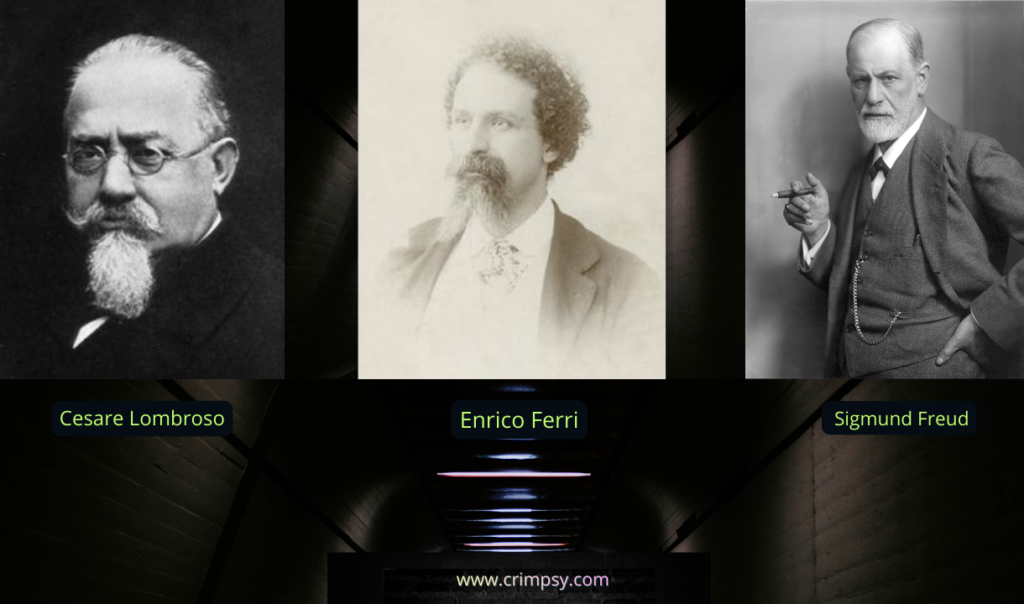
Conversely, the biological school re-emerged with Cesare Lombroso, who attempted to explain crime through innate characteristics of the criminal. Despite the determinism of his theory, it opened debate about the relationship between the body and behavior. Enrico Ferri further developed this approach, integrating biological and social factors, asserting that crime results from a complex interaction between the individual and their environment.
It is thus clear that criminal behavior cannot be explained by a single school; it results from the intersection of multiple approaches: psychological, behavioral, social, economic, and biological. Each school reveals a facet of the truth but does not monopolize it. A deep understanding of crime requires combining these perspectives and viewing humans as complex beings shaped at the intersection of internal and external forces, freedom and compulsion, individual and society.
Fourth: Applications of Criminal Psychology
The practical aspect of criminal psychology is evident in its extension beyond theoretical explanation to multiple applied fields, making it an essential tool for understanding and dealing with crime. One prominent area is criminal investigation, where psycho-behavioral analysis is used to determine offender profiles, known as the “psychological profile.” This method studies behavior patterns, the nature of the crime, and the manner of execution to construct an understanding of the offender’s personality.
This field has developed significantly thanks to contemporary criminal psychologists, who integrate classical theories with modern data from psychology and neuroscience. The psychological profile aims not only to identify the offender but also to understand motives and predict future behavior, helping prevent crimes before they occur.
In the judicial domain, criminal psychology plays a critical role in assessing criminal responsibility. Experts analyze the defendant’s mental state to determine whether they are fully capable of bearing responsibility. This raises a profound philosophical question: can a person be held accountable if they do not have full control over their actions? This returns us to the debate between freedom and determinism, positioning criminal psychology as a tool to rethink justice.
In correctional institutions, this science is used to design rehabilitation programs aimed at modifying criminal behavior. These programs do not focus solely on punishment but seek to understand and address the causes of deviance. Carl Jung’s ideas are relevant here, as he posited that humans carry a “shadow,” the dark aspect of personality, whose neglect leads to its manifestation in deviant behavior. Rehabilitation requires confronting and understanding this aspect.
Albert Bandura’s ideas also contributed to behavioral therapy programs, where behavior is modified through learning and redirection. The offender is not a fixed entity but can be changed if provided with a suitable environment.
In crime prevention, criminal psychology seeks to identify factors leading to deviance for early intervention. This includes work in schools, disadvantaged neighborhoods, and social institutions to build a healthy environment that reduces the likelihood of crime. Here the humanistic dimension of this science is evident: it aims not only to punish the offender but to prevent crime from arising in the first place.
More recently, criminal psychology intersects with neuroscience, studying the brain’s influence on criminal behavior. This approach revisits the age-old question in a new light: is crime a choice or a biological result? The question remains open, making the field fertile ground for research and reflection.
Conclusion
In conclusion, criminal psychology is not merely the study of crime but a window into understanding humans in their most complex states. It reveals that criminal behavior is not a superficial phenomenon but the outcome of deep psychological and social conflicts.
Through the insights of Sigmund Freud, Albert Bandura, and Erich Fromm, we understand that comprehending crime requires a comprehensive approach combining the psyche, society, and philosophy.
Developing this field contributes not only to explaining crime but also to preventing it and achieving more humane justice based on understanding rather than punishment alone.

References
- Crimpsy – Introduction to Criminology | Learn about criminology
- Crimpsy – Criminality as a Collective Issue
- Crimpsy – Socioeconomic Factors in Criminology
- Crimpsy – Applications of Criminology: How It Helps Combat Crime
- Crimpsy – The Theory of Criminal Formation: From Lombroso to Ferri
- Crimpsy – The Broad Concept of Criminology
- Bandura, A. (1977). Social Learning Theory. Englewood Cliffs, NJ: Prentice Hall.
- Freud, S. (1923). The Ego and the Id. London: Hogarth Press.
- Sutherland, E. H. (1947). Principles of Criminology (4th ed.). Philadelphia: Lippincott.
- Eysenck, H. J. (1977). Crime and Personality (3rd ed.). London: Routledge.
- Psychological Health in Criminal Justice (Open Access Article + PDF)
- Lombroso, C. (1876). Criminal Man. Turin: Bocca.
- Ferri, E. (1896). Criminal Sociology. New York: Appleton.
- DiTullio, V. (1980). Forensic Psychology and Criminal Behavior. New York: Academic Press.
- Journal of Investigative Psychology and Offender Profiling (Official Journal)
- Fromm, E. (1973). The Anatomy of Human Destructiveness. New York: Holt, Rinehart & Winston.
- Becker, H. S. (1963). Outsiders: Studies in the Sociology of Deviance. New York: Free Press.