
Introduction: Cesare Lombroso: The Father of Criminal Anthropology
Criminology, as we know it today, was not always recognized as a formal academic field. Its roots stretch back to the 19th century when the world began to explore crime not only as a moral failing but as a scientific phenomenon. At the heart of this evolution was Cesare Lombroso, an Italian physician and criminologist whose controversial ideas marked the beginning of modern criminological thought. Though many of his theories have since been revised or rejected, his influence remains monumental. This article unveils the complex figure of Lombroso, tracing his contributions, examining his theories, and exploring the birth of criminological thought, which he so profoundly shaped.
While Cesare Lombroso’s views stirred great controversy, they also compelled future scholars to question the moral and environmental assumptions of criminality. This in itself was a pivotal moment that shifted crime discourse from moral blame to empirical investigation.
The Early Life of Cesare Lombroso
Born in Verona, Italy, in 1835, Cesare Lombroso was a man of many interests. He studied medicine at the University of Pavia, where he developed a fascination with psychiatry and the human body. His early medical work brought him into contact with the marginalized and mentally ill, an experience that greatly influenced his later theories about crime and biology.
As a military doctor, Lombroso encountered numerous prisoners and soldiers, which led him to consider the biological and psychological aspects of criminal behavior. These early experiences would lay the foundation for his most significant—and most controversial—contributions to criminology.
Lombroso’s diverse intellectual background—spanning literature, history, and science—provided him with a unique interdisciplinary approach to criminology. His encounters with mental illness and deviance during his early career were pivotal in challenging conventional moralist explanations of crime.
Criminal Man: A Revolutionary Concept
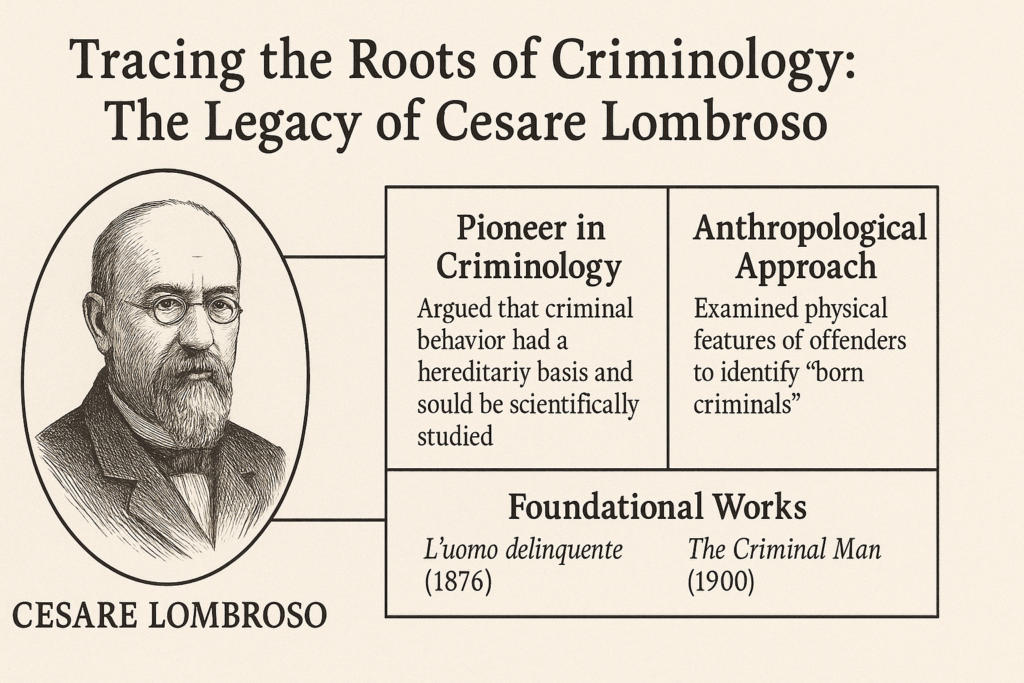
In 1876, Lombroso published his groundbreaking book “The Criminal Man“, where he presented a radical idea: criminality is inherited, and certain people are born with physical traits that predispose them to crime. This notion gave birth to biological determinism in criminology.
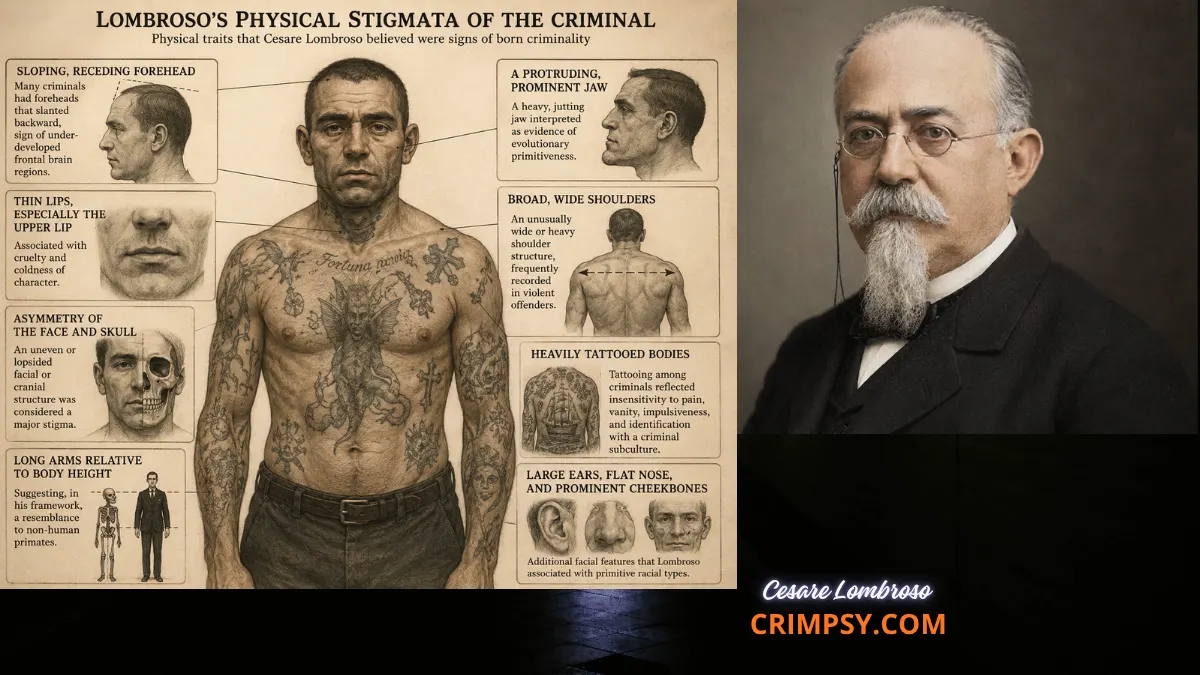
According to Lombroso, criminals exhibited atavistic traits—features that were evolutionary throwbacks to a more primitive stage of human development. These included characteristics such as a sloping forehead, large jaws, high cheekbones, and asymmetrical facial features. This theory implied that crime was not entirely a product of environment or free will but rooted in biology.
Thus began the birth of criminological thought—shifting the focus from purely moral and legal considerations to scientific inquiry.
Though the theory of atavism has been discredited, its legacy lives on in today’s nature vs. nurture debates. Lombroso’s attempt to link biology to behavior inspired future developments in genetics, psychiatry, and even evolutionary psychology.
Cesare Lombroso and the Birth of Criminological Thought
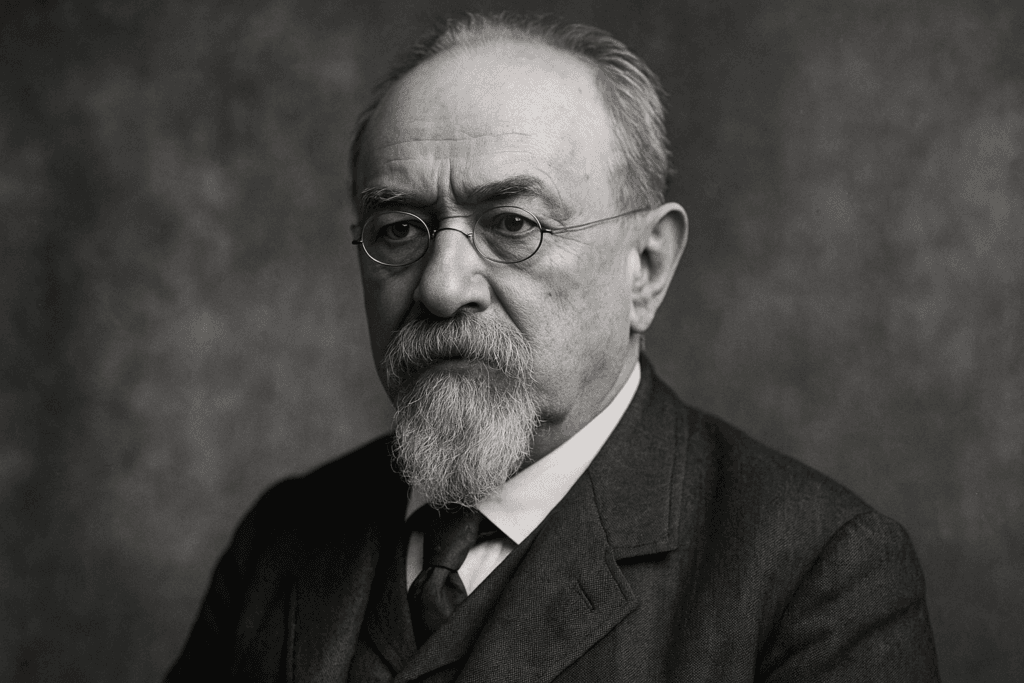
Lombroso’s ideas represented a seismic shift in how society viewed criminals. Before him, criminal behavior was largely attributed to sin, poor upbringing, or poverty. He argued that certain individuals were “criminals by nature”, destined to break the law due to their biological makeup.
This perspective sparked a new wave of criminological inquiry, encouraging researchers to consider empirical data, observation, and measurement. Though highly reductionist, Lombroso’s work encouraged other thinkers to explore the multifaceted nature of crime, including its psychological, social, and environmental dimensions.
Lombroso’s methods helped introduce statistical and anatomical analysis into criminology, setting a precedent for evidence-based practices in legal medicine and crime studies. His work marks the start of criminal anthropology as a legitimate discipline.
Lombroso’s influence also transformed the methodology of crime research. Prior to his work, discussions about crime were largely speculative and philosophical. Lombroso introduced systematic observation, measurement, and comparative analysis into criminological studies. Even though his methods were imperfect, they encouraged future scholars to rely more heavily on empirical evidence.
His work also contributed to the professionalization of criminology as a separate academic discipline. Universities and legal institutions began recognizing crime as a subject worthy of independent scientific investigation. This institutional recognition helped establish criminology as a field connected to sociology, psychology, anthropology, and law.
Furthermore, Lombroso challenged traditional assumptions about punishment. If criminal behavior had biological or psychological roots, then punishment alone could not fully solve the problem of crime. This perspective encouraged debates about prevention, rehabilitation, and social reform that continue to shape criminological thought today.
The Legacy of Lombroso: More Than Skull Shapes
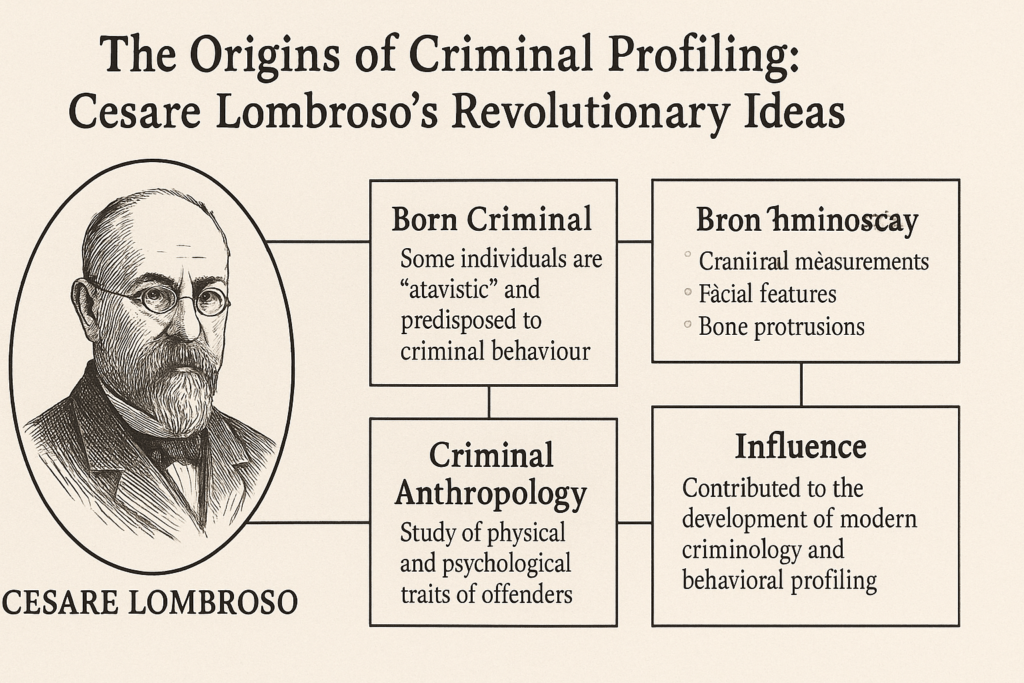
One of the most infamous aspects of Lombroso’s theory was his emphasis on cranial measurements and facial features. His research involved analyzing the skulls of deceased criminals, attempting to draw links between physical appearance and criminal behavior. This approach would later form the basis for criminal profiling, though in a much more sophisticated form.
Modern criminologists now understand that Lombroso’s reliance on physiognomy and phrenology was flawed. His methods lacked statistical rigor and were influenced by cultural and racial biases. However, his central premise—that crime can be studied scientifically—remains one of his most important contributions.
Thus, we move from the era of skull shapes to the dawn of complex crime theories that examine both nature and nurture.
Even critics of Lombroso’s physical typologies acknowledge that his classification of criminal behavior helped stimulate the broader scientific community into refining more accurate typologies, including psychological and sociological frameworks.
Although Lombroso’s physical theories have been widely criticized, his work left an undeniable methodological legacy. He encouraged scholars to collect evidence systematically, compare patterns among offenders, and search for recurring characteristics associated with criminality. These practices eventually evolved into more sophisticated scientific techniques used in modern criminology.
His influence can also be observed in forensic psychiatry and criminal psychology. Lombroso was among the first scholars to emphasize the relationship between mental disorders and criminal conduct. Modern forensic experts continue exploring links between neurological conditions, personality disorders, trauma, and antisocial behavior, though with far greater scientific precision than Lombroso possessed.
Additionally, Lombroso’s theories stimulated intense academic criticism, which paradoxically strengthened criminology as a discipline. Scholars who opposed his conclusions developed alternative sociological and psychological explanations of crime, leading to a richer and more balanced understanding of criminal behavior over time.
From Skull Shapes to Crime Theories: Cesare Lombroso’s Impact on Criminology
Although most of Lombroso’s biological determinism has been discredited, it paved the way for more nuanced theories in the 20th and 21st centuries. Today, criminology integrates biology, psychology, sociology, and even neuroscience to better understand criminal behavior.
Lombroso’s emphasis on data collection and scientific methods inspired generations of criminologists to conduct research on crime causation. His legacy lies in creating the foundation upon which modern criminological theories were built.
Furthermore, Lombroso’s ideas encouraged an interdisciplinary approach, one that we now see in fields such as forensic psychology, criminal profiling, and criminological anthropology.
Modern scholars often revisit Lombroso’s work to better understand the historical roots of bias in forensic science. This reflection has encouraged more inclusive and ethical research in present-day criminology.
The evolution of criminological theory after Lombroso demonstrates how scientific disciplines grow through both innovation and criticism. Later criminologists moved beyond biological determinism and developed theories emphasizing poverty, inequality, peer influence, social learning, and urban conditions. Nevertheless, these later theories often emerged in response to Lombroso’s original framework.
His influence is particularly visible in contemporary biosocial criminology, which examines how genetic predispositions may interact with environmental conditions. Unlike Lombroso’s simplistic conclusions, modern biosocial research recognizes that biology alone cannot explain crime. Instead, criminal behavior is viewed as the result of multiple interacting factors operating throughout an individual’s life.
Lombroso’s legacy also survives in the continuing use of scientific technologies within criminal investigations. Modern criminology relies on DNA analysis, behavioral profiling, neuroimaging, and statistical modeling—methods that reflect the same scientific ambition Lombroso introduced, even if modern science rejects many of his original assumptions.
Tracing the Roots of Criminology: The Legacy of Cesare Lombroso
The history of criminology cannot be told without Cesare Lombroso. Even as his methods fell out of favor, his influence endured. He was among the first to suggest that criminal behavior could be predicted, understood, and potentially prevented.
Many early criminologists, such as Enrico Ferri and Raffaele Garofalo, expanded upon Lombroso’s work, leading to the formation of Italian Positivist Criminology. These thinkers emphasized societal influences, legal reform, and rehabilitation, blending biological and environmental theories.
Today, Lombroso’s legacy is both respected and scrutinized. While modern science has shown that crime cannot be determined solely by biology, his pioneering role in systematizing the study of crime remains pivotal.
Lombroso’s impact is also seen in the development of criminal justice reform movements, particularly those advocating for rehabilitation over retribution. His belief in identifying causes of criminal behavior indirectly supports humane treatment of offenders.
Cesare Lombroso’s Criminal Man: A Turning Point in Criminology
“The Criminal Man” was more than a book—it was a turning point. It sparked debate, inspired research, and divided opinion. Critics accused Lombroso of scientific racism and ethical insensitivity, while supporters lauded him for bringing rigor and objectivity to the study of crime.
What makes the book remarkable is its blend of anatomy, psychology, and sociology—even if imperfect. It laid the groundwork for later studies on psychopathy, antisocial behavior, and mental illness in criminals.
Today, criminologists refer to Lombroso’s work as proto-scientific, acknowledging its flaws while appreciating its historical importance. His book forced society to confront the idea that crime was not just a moral failing, but a human phenomenon worth scientific investigation.
The publication of The Criminal Man ignited global academic discussion. Its influence reached beyond Italy, inspiring criminological schools in France, Russia, and Latin America. This transnational impact cemented Lombroso’s place in the history of forensic science.
The Origins of Criminal Profiling: Cesare Lombroso’s Revolutionary Ideas
Modern criminal profiling owes a debt—however indirect—to Lombroso. While his approach was rudimentary, the idea that a person’s background, appearance, or behavior could offer clues about criminality was groundbreaking.
Today’s profilers use psychological analysis, behavioral science, and data-driven models to assess potential suspects. The field has moved far beyond atavistic features, but the seed of profiling was planted by Lombroso’s early attempts to categorize and analyze criminals systematically.
His methods may be outdated, but the conceptual leap from punishing crime to understanding criminals remains one of Lombroso’s enduring contributions.
While modern profiling rejects Lombroso’s physical determinism, his basic premise—that patterns can be found in the traits and behaviors of offenders—remains a foundation of investigative psychology today.
Controversies and Criticisms
Lombroso’s work was far from universally accepted. Even during his lifetime, scholars criticized his methods and conclusions. His theories were seen as deterministic, ignoring the role of free will and social context.
Additionally, his work often reflected cultural and racial biases, particularly in associating certain physical traits with non-European populations. These aspects have rightly come under ethical scrutiny in modern times.
Despite these issues, Lombroso’s pioneering work prompted the development of more balanced and inclusive theories. It also sparked important ethical conversations about how science should interact with justice.
The Modern Relevance of Lombroso’s Ideas
Although Lombroso’s biological determinism is largely obsolete, his desire to apply science to crime remains a vital principle in modern criminology. Research into genetics, brain function, and early childhood development continues to uncover how biology and environment interact to influence behavior.
Contemporary criminologists adopt a biosocial perspective, acknowledging the complex interplay of genes, environment, psychology, and society. This synthesis owes much to Lombroso’s early—if misguided—attempts to do the same.
Conclusion: The Mind Behind Criminology’s Origins
Cesare Lombroso was a visionary, a controversial figure, and undeniably a pioneer. He helped transform criminology from a philosophical and moral inquiry into a discipline rooted in empirical observation and scientific analysis. While many of his conclusions were flawed, his boldness in asking difficult questions opened the door for generations of researchers.
In unveiling Cesare Lombroso, we uncover not only the origins of modern criminology but also the enduring tension between science and society, between understanding and judgment, and between what we were and what we strive to become.
The development of biological criminology also inspired later scholars to explore the relationship between human behavior, psychology, and social conditions. Thinkers such as Sigmund Freud contributed psychological perspectives that emphasized unconscious motives, inner conflicts, and personality development in understanding criminal behavior. Freud’s psychoanalytic theories expanded criminology beyond biology, introducing deeper analyses of the human mind and emotional experience.
At the same time, criminologists like Raffaele Garofalo helped refine positivist criminology by integrating legal, moral, and social dimensions into the study of crime. Garofalo’s work demonstrated that criminality could not be explained solely through physical characteristics but required a broader understanding of society, ethics, and individual adaptation. Together, Lombroso, Freud, and Garofalo contributed to the evolution of criminology into a multidisciplinary science.
Today, modern criminology recognizes that crime results from a complex interaction between biological, psychological, and environmental factors. Contemporary research in genetics, neuroscience, sociology, and forensic psychology continues to reflect the early ambition of biological criminology: understanding why individuals commit crimes and how societies can respond more effectively. Despite its controversies, the legacy of biological criminology remains deeply embedded in the ongoing search for scientific explanations of criminal behavior.
Frequently Asked Questions
Who was Cesare Lombroso?
Cesare Lombroso was an Italian physician, psychiatrist, and criminologist who is widely considered one of the founders of modern criminology and biological criminology. He became famous for his theory that some individuals are “born criminals” with inherited physical and psychological traits linked to criminal behavior.
What is The Criminal Man?
The Criminal Man is Lombroso’s most influential book, first published in 1876. In this work, he argued that criminal behavior could be scientifically studied and that certain offenders displayed biological characteristics connected to primitive evolutionary traits.
What is the theory of the born criminal?
The theory of the born criminal suggests that some individuals are naturally predisposed to criminal behavior due to inherited biological traits. Lombroso believed these individuals could be identified through physical characteristics such as skull shape, facial asymmetry, and other anatomical features.
Why was Lombroso criticized?
Lombroso was criticized because many of his theories lacked scientific accuracy and relied heavily on racial and biological stereotypes. Critics argued that he ignored important social factors such as poverty, education, and environment when explaining criminal behavior.
How did Lombroso influence modern criminology?
Despite criticism, Lombroso helped transform criminology into a scientific discipline based on observation and empirical research. His work influenced later developments in forensic science, criminal psychology, offender profiling, and biological criminology.
What is biological criminology?
Biological criminology is a branch of criminology that studies how biological factors such as genetics, brain structure, hormones, and neurological conditions may influence criminal behavior. Modern biological criminology combines biological research with psychological and social explanations of crime.
What was the relationship between Lombroso and positivist criminology?
Lombroso was one of the leading figures of positivist criminology, a school that emphasized scientific methods and empirical observation in studying crime. Positivist criminologists believed criminal behavior could be understood through measurable causes rather than moral judgment alone.