
Is crime written in our DNA? Can brain structure predict violence? Biological criminology explores the science behind these provocative questions — and the answers are more nuanced than you might expect.
What Is Biological Criminology?
Biological criminology is a sub-field of criminology that examines the role of biological factors — including genetics, neuroscience, hormones, and evolutionary processes — in shaping criminal behavior. Rather than focusing solely on social or environmental causes of crime, biological criminologists argue that the body and brain play a significant, often underappreciated role in why some individuals are more prone to antisocial conduct than others.
Biological criminology developed during the nineteenth century in response to dissatisfaction with classical theories of crime. Classical theorists such as Cesare Beccaria and Jeremy Bentham argued that individuals commit crimes after rational calculations of pleasure and pain. Crime, according to the classical school, resulted from free choice.
However, positivist criminologists challenged this assumption. They argued that criminal behavior could not always be explained by rationality because many offenders appeared impulsive, irrational, psychologically disturbed, or biologically abnormal. Influenced by developments in medicine, biology, evolutionary theory, and psychiatry, positivists attempted to identify the scientific causes of crime.
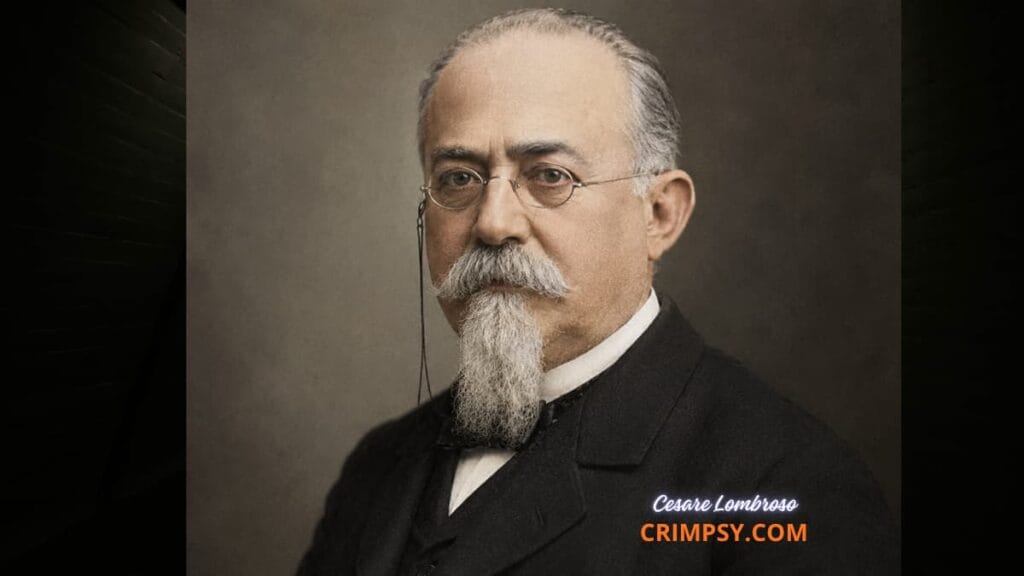
Cesare Lombroso and the Birth of Criminal Anthropology
The emergence of biological criminology cannot be discussed without examining the revolutionary and controversial ideas of Cesare Lombroso, the Italian physician often regarded as the father of modern criminology. Before Lombroso, crime was generally interpreted through religious doctrine, moral philosophy, or legal reasoning. Criminals were viewed as rational individuals who freely chose to violate the law. Lombroso fundamentally challenged this classical conception by arguing that many offenders were biologically different from ordinary people and that criminality itself could be inherited and scientifically identified.
Influenced by Darwinian evolution and nineteenth-century medical science, Lombroso developed the theory of the “born criminal.” According to his perspective, certain individuals represented evolutionary throwbacks who possessed primitive physical and psychological characteristics inherited from earlier stages of human evolution. He used the term “atavism” to describe this regression toward ancestral traits. Lombroso believed that these biological abnormalities created a natural predisposition toward violence, impulsivity, and antisocial behavior.
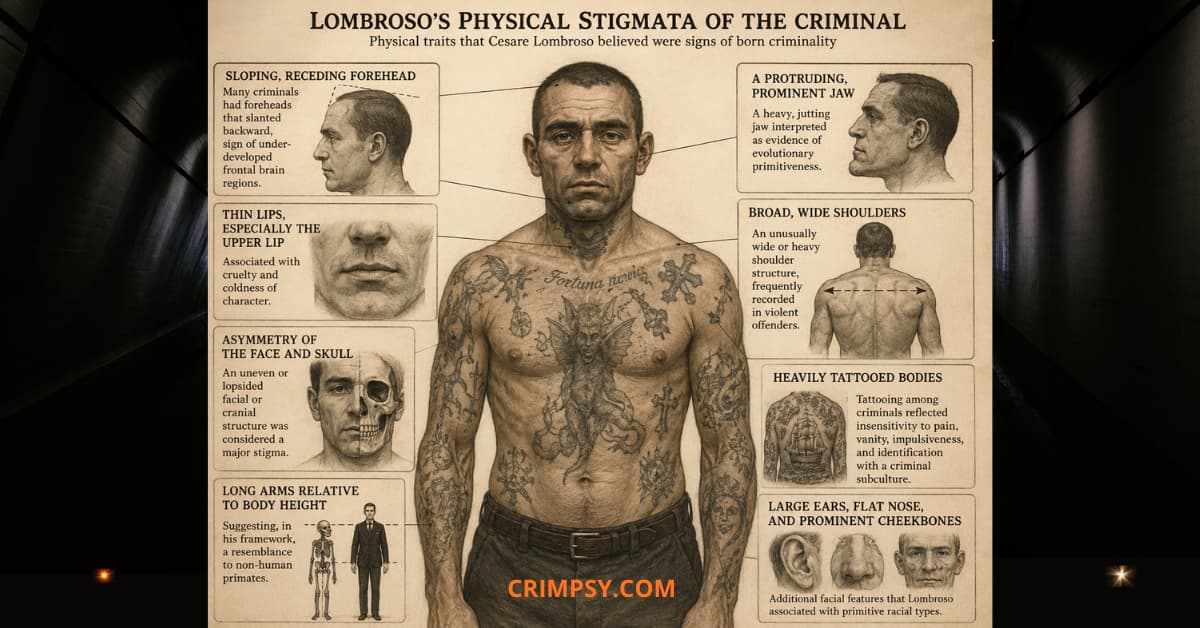
Lombroso attempted to support his theory through empirical observation and medical examination. He studied thousands of prisoners, soldiers, and psychiatric patients, searching for anatomical signs that distinguished criminals from non-criminals. According to Lombroso, offenders frequently displayed physical stigmata such as asymmetrical faces, protruding jaws, flattened noses, unusually large ears, long arms, and sloping foreheads. He argued that these traits reflected primitive evolutionary ancestry and revealed the offender’s biological inferiority.
However, Lombroso’s theory extended beyond physical appearance alone. He also claimed that born criminals possessed distinctive psychological characteristics. They were described as impulsive, emotionally cold, morally insensitive, and incapable of genuine remorse. In Lombroso’s view, criminality was not simply a legal or moral issue but rather a pathological condition rooted in biology itself. This interpretation transformed criminology into a scientific discipline focused on studying the offender rather than merely studying.
L’Uomo Delinquente — The Criminal Man (1876)
In 1876, Lombroso published his landmark — and ultimately infamous — work, L’Uomo Delinquente (The Criminal Man). The book went through five editions and was translated across Europe, making Lombroso the most influential criminologist of the 19th century. Its central thesis was radical for the time: criminals are not simply morally corrupt individuals making bad choices — they are a distinct biological type, identifiable by their physical features.
The Physical Stigmata Lombroso Identified
Through his examinations of hundreds of inmates and autopsies of deceased criminals, Lombroso compiled a detailed list of physical traits he believed were disproportionately common among offenders. These included:
- A sloping, receding forehead — Lombroso observed that many criminals had foreheads that slanted backward, which he interpreted as a sign of underdeveloped frontal brain regions associated with higher reasoning and moral control.
- A protruding, prominent jaw — A heavy, jutting jaw was among the most frequently cited features, interpreted as evidence of evolutionary primitiveness.
- Thin lips, particularly the upper lip — Lombroso noted that the upper lip of habitual criminals was often notably thin, which he associated with cruelty and coldness of character.
- Broad, wide shoulders — An unusually wide or heavy shoulder structure was frequently recorded in his criminal subjects, particularly among violent offenders.
- Heavily tattooed bodies — Lombroso was struck by how frequently criminals bore tattoos. He devoted an entire chapter of L’Uomo Delinquente to the topic, arguing that tattooing among criminals reflected their insensitivity to pain, their vanity, their impulsiveness, and their identification with a criminal subculture. He saw tattoos not merely as a social habit but as a biological and psychological marker of deviance.
- Asymmetry of the face and skull — An uneven or lopsided facial or cranial structure was considered a major stigma.
- Large ears, a flat nose, and prominent cheekbones — Additional facial features that Lombroso associated with primitive racial types.
- Long arms relative to body height — Suggesting, in his framework, a resemblance to non-human primates.
Raffaele Garofalo and the Theory of Natural Crime
Raffaele Garofalo played a central role in developing the Italian positivist school and is often credited with popularizing the term “criminology.” Unlike Lombroso, Garofalo focused less on physical stigmata and more on psychological and moral abnormalities. He believed that crime should be understood through the study of human moral sentiments rather than legal definitions alone.
Garofalo introduced the concept of “natural crime,” arguing that certain acts are universally condemned because they violate fundamental human feelings such as compassion, honesty, and moral integrity. According to his theory, individuals who commit serious crimes suffer from psychological deficiencies that prevent them from experiencing normal moral emotions. In this sense, criminals were viewed as morally anomalous individuals incapable of adapting to civilized society.
{Natural Crime} = {Violation of Universal Moral Sentiments}
Garofalo believed that society possesses a natural right to defend itself against dangerous offenders. Consequently, he supported harsh measures such as permanent imprisonment, exile, and even execution for individuals considered incapable of moral rehabilitation. His theory strongly influenced later ideas concerning dangerous offenders, preventive detention, and criminal profiling.
Enrico Ferri and the Expansion of Positivist Criminology
While Lombroso focused primarily on biological abnormalities, Enrico Ferri expanded positivist criminology by introducing social, environmental, and economic dimensions into the explanation of crime. Ferri believed that criminal behavior could not be understood through biology alone because human actions are shaped by a complex interaction between individual constitution and external conditions. His work therefore represented an important transition from pure biological determinism toward a broader sociological understanding of criminality.
Ferri argued that crime results from multiple interconnected causes including poverty, climate, education, population density, alcoholism, family conditions, and social organization. Although he accepted Lombroso’s biological assumptions, he insisted that environmental influences also play a decisive role in shaping criminal behavior. This “multiple-factor” approach made Ferri one of the first criminologists to combine biological and social explanations within a unified theoretical framework.
{Crime} = f({Biology} + {Social Environment} + {Economic Conditions})
Unlike classical theorists who emphasized punishment and free will, Ferri believed that many offenders were driven by forces beyond their control. Consequently, he argued that criminal justice systems should focus less on moral blame and more on social defense and prevention. According to Ferri, the primary role of the state was to protect society from dangerous individuals whose biological or social conditions predisposed them to criminal behavior.
Ferri’s contribution was particularly significant because it broadened the scope of criminology. Under his influence, criminology began examining economic structures, social conditions, and environmental pressures alongside biological predispositions. In many ways, his work anticipated modern sociological criminology and contemporary biosocial theories, which recognize that criminality emerges through interaction between individual vulnerabilities and environmental influences.
Sigmund Freud and the Psychoanalytic Interpretation of Crime
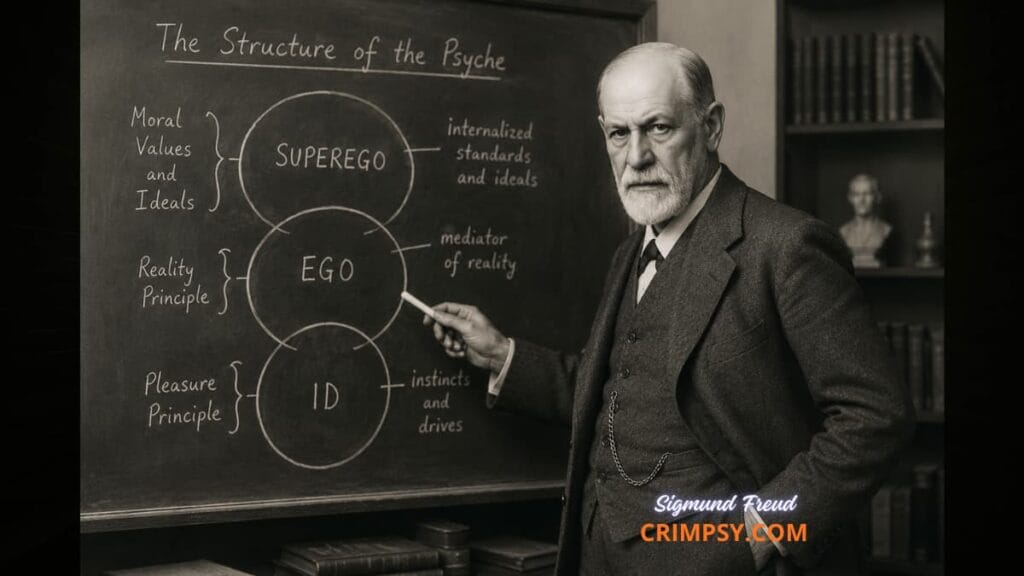
The development of criminology during the twentieth century increasingly incorporated psychological explanations of criminal behavior, particularly through the influence of Sigmund Freud. Unlike Lombroso and the Italian positivists, Freud did not focus on skull measurements or physical abnormalities. Instead, he explored the hidden psychological conflicts that shape human behavior. Freud’s psychoanalytic theory transformed criminology by emphasizing the unconscious mind, childhood experiences, and personality development as central causes of crime.
Freud proposed that human personality consists of three interacting structures: the id, the ego, and the superego. The id represents instinctive desires and aggressive impulses seeking immediate gratification. The superego functions as the moral conscience internalized through family and socialization. The ego mediates between instinctual desires and social reality. According to Freud, criminal behavior emerges when these psychological structures become unbalanced.
{Personality} = {Id} + {Ego} + {Superego}
Freud argued that offenders often possess weak or underdeveloped superegos, making them unable to control destructive impulses originating from the id. Childhood trauma, neglect, abusive parenting, and unresolved emotional conflicts may prevent the healthy development of personality. Consequently, criminal behavior can reflect unconscious aggression, frustration, guilt, or repressed desires rather than rational decision-making alone.
Psychoanalytic criminology profoundly influenced forensic psychology, criminal profiling, and modern understandings of personality disorders. Freud’s theories encouraged criminologists to examine emotional trauma, unconscious motivation, and family relationships as major contributors to criminality. Although some aspects of psychoanalysis remain controversial, Freud’s influence on criminological thought remains immense because he introduced the idea that crime may originate within the hidden psychological structure of the individual rather than solely from biological defects or external social pressures.
Conclusion: Final Reflections on Biological Criminology
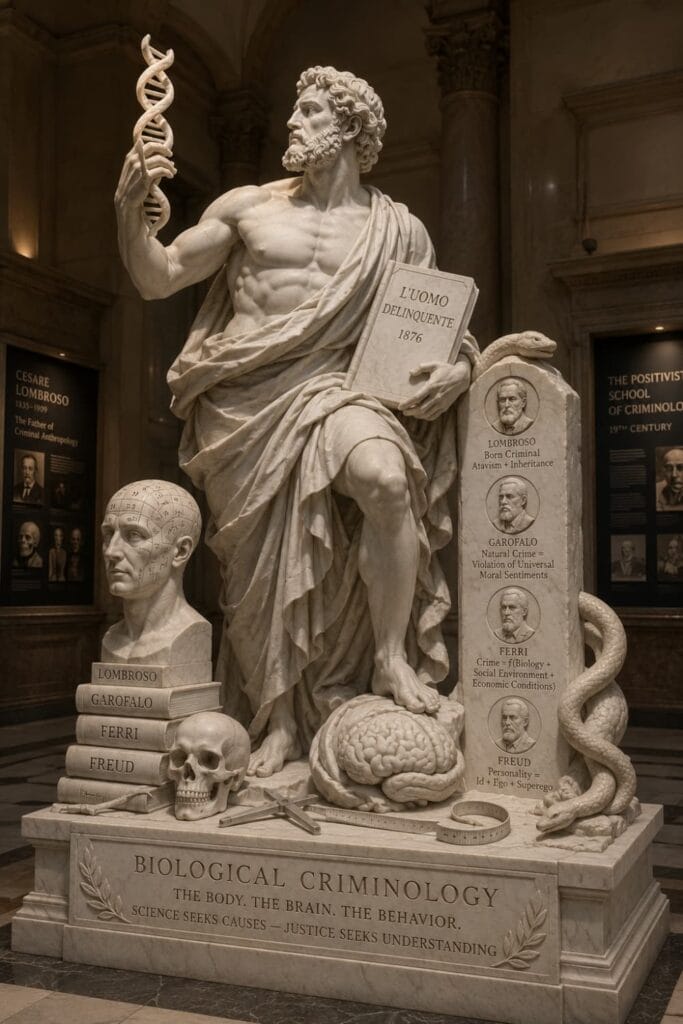
Biological criminology represents one of the most influential and controversial movements in the history of criminological thought. Beginning with the revolutionary ideas of Cesare Lombroso, criminologists attempted to explain criminal behavior through scientific analysis rather than purely moral or legal interpretations. Lombroso’s theory of the “born criminal” introduced the idea that biological and inherited characteristics may predispose certain individuals toward crime, while Enrico Ferri expanded this perspective by incorporating social and environmental factors into the study of criminality. Raffaele Garofalo further contributed to the positivist school by emphasizing moral and psychological abnormalities as central elements in criminal behavior.
The evolution of criminology did not stop with biological explanations alone. The psychoanalytic theories of Sigmund Freud shifted attention toward the unconscious mind, childhood trauma, personality development, and internal psychological conflict. Freud demonstrated that crime may emerge not only from biological predispositions but also from unresolved emotional struggles and defective personality structures. Together, these thinkers transformed criminology into an interdisciplinary science connected to medicine, psychology, sociology, psychiatry, and neuroscience.
Although many early biological theories have been criticized for determinism, methodological weaknesses, and racial bias, their historical importance remains undeniable. Modern biosocial criminology no longer views criminals as individuals biologically destined to offend. Instead, contemporary research recognizes that criminal behavior results from a complex interaction between genetics, neurological development, psychological conditions, and social environment. Current studies in neurocriminology, behavioral genetics, and forensic psychology continue to explore how biological and environmental factors interact in shaping human behavior.
Ultimately, biological criminology remains a foundational chapter in the development of modern criminological science. Despite its controversies, it introduced empirical observation, scientific inquiry, and interdisciplinary analysis into the study of crime. The theories of Lombroso, Ferri, Garofalo, Freud, and later biosocial researchers continue to influence debates surrounding criminal responsibility, human behavior, forensic psychology, and the complex relationship between biology and crime.
References
- Lombroso, C. (1876). L’Uomo Delinquente (The Criminal Man). Hoepli.
- Bentham, J. (1789). An Introduction to the Principles of Morals and Legislation.
- Ferri, E. (1917). Criminal Sociology. D. Appleton and Company.
- Garofalo, R. (1885). Criminology. (Foundational text of natural crime theory)
- Freud, S. (1923). The Ego and the Id.
- Beccaria, C. (1764). On Crimes and Punishments.