
Introduction: The Founding Minds of Criminology
Crime has long remained one of the most complex and debated phenomena in human society. Across different historical periods, scholars have attempted to explain why individuals violate social norms and engage in unlawful behavior. Early explanations often relied on moral judgment, religious interpretation, and legal doctrine, viewing crime primarily as an individual choice or ethical failure. Over time, however, the study of crime evolved into an independent scientific discipline that sought to understand criminal behavior through systematic observation, empirical inquiry, and interdisciplinary analysis.
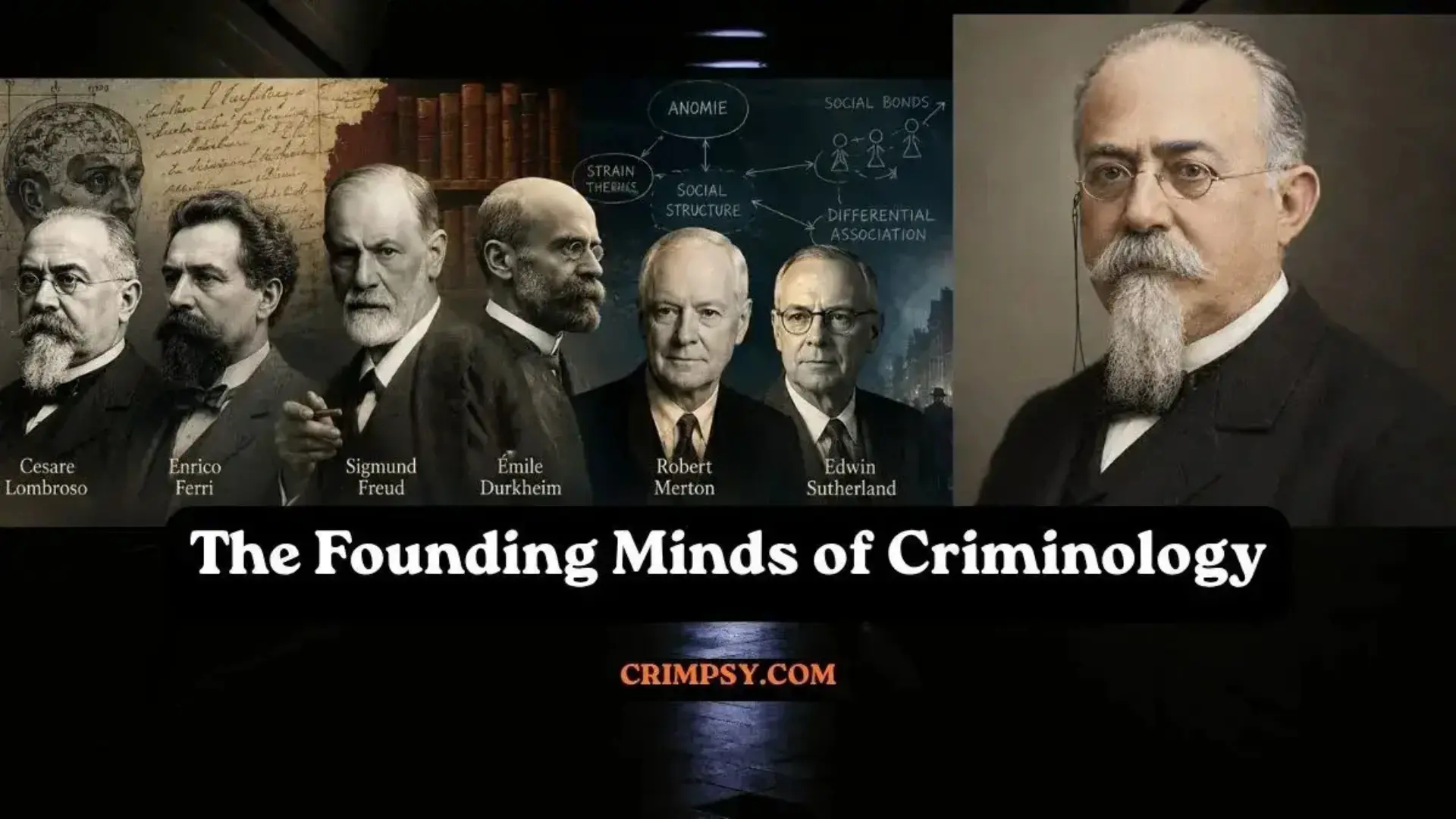
The emergence of criminology was shaped by a remarkable group of thinkers whose ideas transformed the understanding of crime and its causes. From Cesare Lombroso’s pioneering biological explanations and the rise of positivist criminology, to Sigmund Freud’s psychological interpretation of human behavior, and from Émile Durkheim’s sociological insights to Robert Merton’s theory of social strain, each scholar introduced a distinct framework for interpreting criminal conduct. Later contributors such as Enrico Ferri, Benigno Di Tullio, Edwin Sutherland, Travis Hirschi, Howard Becker, and James Q. Wilson and Richard Herrnstein further expanded the field by integrating social, psychological, clinical, and environmental dimensions into criminological inquiry.
Together, these intellectual traditions demonstrate that crime cannot be reduced to a single cause or explained through one universal theory. Instead, criminology developed as a multidisciplinary field that examines the interaction between biological predispositions, psychological processes, social structures, cultural influences, and environmental conditions. By exploring the contributions of these foundational thinkers, this article traces the evolution of criminological thought and highlights the theories that continue to shape contemporary understandings of crime and criminal behavior.
1. Cesare Lombroso
Biological Theory of Crime: Often regarded as one of the founders of modern criminology, Cesare Lombroso introduced the idea that some individuals are biologically predisposed to criminal behavior due to inherited traits. Facial Features and Crime: Lombroso suggested that certain physical characteristics, such as skull shape and facial structure, could indicate a tendency toward crime. This concept, known as “criminal typology,” formed the basis of his work. Impact: Although his theories were later criticized, Lombroso established a new scientific approach by examining crime through a biological lens, greatly influencing criminal psychology and the study of criminal behavior.
Cesare Lombroso occupies a unique place in the history of criminology because he transformed the study of crime into a systematic field of scientific inquiry. Before Lombroso, criminal behavior was largely interpreted through philosophy, morality, theology, or legal doctrine. Lombroso introduced a radically different approach by insisting that offenders themselves should become the object of observation, measurement, and empirical analysis. This methodological shift led many scholars to describe him as the father—or intellectual founder—of modern criminology and the central figure of the Italian positivist school.
Criminal Anthropology
Lombroso’s greatest contribution was not merely proposing a biological explanation of crime, but attempting to establish a scientific method for understanding criminal behavior. Through medical observation, comparative analysis, and anthropological research, he argued that crime should be studied as a human phenomenon influenced by identifiable factors rather than viewed exclusively as a moral failure. His work gave birth to criminal anthropology and opened the way for later biological, psychological, and sociological approaches in criminological research.
Criminal Man and the Birth of Positivist Criminology
Lombroso’s landmark publication L’Uomo Delinquente (Criminal Man), first published in 1876, became one of the most influential books in the history of criminology. In this work, he developed classifications of offenders and introduced the controversial concept of the “born criminal.” Although many of these conclusions were later criticized and revised, the book established the idea that crime could be investigated scientifically through evidence and observation. It became the intellectual foundation upon which later positivist criminologists expanded the field.
Influence Beyond His Own Theory
The enduring importance of Lombroso does not rest solely on whether his biological conclusions were correct. His historical significance lies in changing the central question of criminology—from What punishment should follow crime? to Why do individuals commit crime? That transformation influenced later generations of scholars, including Enrico Ferri and many twentieth-century criminologists who developed broader explanations involving social, economic, and psychological factors. Even scholars who rejected Lombroso’s conclusions continued to build upon the scientific orientation that he introduced.
2. Enrico Ferri
As one of the leading figures of the Italian positivist school and a close collaborator of Cesare Lombroso, Enrico Ferri expanded criminological thought beyond purely biological explanations of crime. While Lombroso emphasized inherited traits and physical characteristics, Ferri argued that criminal behavior should be understood through a broader scientific analysis that included social, economic, and environmental influences.
Ferri rejected the classical notion of free will and proposed that crime emerges from a combination of physical, psychological, and social factors. According to his perspective, individuals do not commit crimes entirely by personal choice; rather, criminal conduct develops under the influence of surrounding conditions and internal predispositions. This position helped establish criminology as an empirical and interdisciplinary field.
Unlike approaches centered mainly on punishment, Ferri emphasized prevention and social protection. He believed that legal systems should focus on reducing the causes of crime through reforms in education, economic conditions, and social organization. His ideas contributed to the development of modern criminal policy and preventive criminology.
Legacy and Influence
Ferri’s work significantly broadened the scope of criminology by connecting individual behavior with larger social structures. His book Criminal Sociology became one of the foundational texts of positivist criminology and influenced later theories that examined the relationship between social conditions and criminal behavior.
3. Sigmund Freud
Psychoanalysis in Criminology: Freud’s development of psychoanalysis provided insights into the psychological dimensions of crime, linking criminal behavior to repressed instincts and emotions. The Unconscious Mind and Crime: Freud suggested that criminal actions might stem from unconscious conflicts, such as hidden desires or feelings of guilt. Criminal Motives and Psychotherapy: Freud’s work inspired researchers in criminal psychology to analyze the underlying motives of criminals through psychotherapy, furthering our understanding of crime’s psychological aspects.
The Structure of Personality and Crime
Freud’s model of personality—Id, Ego, and Superego—offered criminologists a framework for understanding how internal psychological conflicts may influence unlawful behavior. Criminal acts could emerge when instinctual impulses overpower moral regulation or when unresolved tensions shape decision-making.
Psychoanalysis and Hidden Motives
Freud argued that human behavior cannot always be understood through conscious reasoning alone. His emphasis on unconscious processes encouraged criminologists to explore trauma, repression, aggression, and emotional conflict as possible contributors to criminal conduct.
4. Benigno Di Tullio
Clinical Criminology and the Study of the Offender
Benigno Di Tullio played an important role in moving criminology toward a clinical and individualized understanding of criminal behavior. Rather than focusing exclusively on crime itself, he emphasized studying the offender as a complete human subject whose actions result from psychological, biological, and social interactions.
Di Tullio argued that criminal conduct cannot be explained by a single cause. He examined how personality formation, emotional development, mental conditions, and environmental experiences interact to influence unlawful behavior. His approach encouraged criminologists to analyze offenders through case-based assessment rather than broad generalizations.
One of Di Tullio’s most influential contributions was his support for individualized rehabilitation. He believed criminal justice systems should not rely solely on punishment but should evaluate each offender’s personal circumstances and develop corrective and therapeutic responses where appropriate.
Di Tullio’s work helped establish what later became known as clinical criminology, a branch that combines criminology, psychology, psychiatry, and behavioral analysis. His influence remains visible in contemporary approaches that emphasize offender assessment, rehabilitation, and social reintegration.
5. Edwin Sutherland
Differential Association Theory: Sutherland proposed that criminal behavior is learned through social interactions, especially with individuals who engage in illegal activities. White-Collar Crime: He also introduced the concept of “white-collar crime,” highlighting that crime is not exclusive to disadvantaged groups but also occurs among affluent and influential individuals, broadening the scope of criminology.
Sutherland challenged the belief that crime resulted primarily from poverty or biology. He argued that criminal values, techniques, and justifications are learned through communication and interaction, making social relationships central to understanding deviance. His introduction of the concept of white-collar crime transformed criminology by showing that illegal behavior exists across social classes. This perspective expanded criminological inquiry into corporations, business misconduct, and institutional power.
His influential books Principles of Criminology and White Collar Crime helped establish sociological criminology as a dominant tradition during the twentieth century.
6. Émile Durkheim
Crime as a Social Phenomenon: Durkheim viewed crime as a natural part of any society, suggesting that it plays a social role in promoting change. Anomie Theory: He argued that high crime rates might result from a breakdown in social norms and values, leading to a state of “anomie,” where individuals feel disconnected from society. Influence on Crime Theories: Durkheim’s insights laid the groundwork for understanding crime through sociological theories and the influence of social structures.
Durkheim argued that crime performs social functions by clarifying moral boundaries and encouraging societies to adapt and evolve. Rather than treating crime as abnormal, he viewed it as a recurring feature of collective life.
His work emphasized how weakened social integration and changing norms can produce instability and deviant behavior. This insight later inspired many sociological theories of crime and social control. Books such as The Division of Labor in Society, The Rules of Sociological Method, and Suicide established Durkheim as one of the most influential social theorists in criminology and sociology.
7. Robert Merton
Strain Theory: Merton’s theory of strain posits that crime may occur when individuals experience a gap between their goals and the legitimate means to achieve them. Innovation and Criminal Behavior: Merton suggested that some individuals may resort to crime as a means of achieving material success when legitimate opportunities are unavailable, influencing theories of crime related to economic and social pressures.
Merton identified five modes of adaptation to this gap, of which innovation is most relevant to crime. In innovation, people accept society’s success goals but substitute illegal or unconventional means when legitimate paths are blocked. Thus, they “innovate” by turning to crime (such as theft, fraud or drug trafficking) in order to obtain wealth or status. This explained how social and economic pressures can produce crime as an adaptive response. Merton’s strain model has been applied widely (e.g. to youth delinquency and white-collar crime) and laid the groundwork for later theories. His classic works, especially Social Structure and Anomie (1938, revised 1949) and Social Theory and Social Structure (1949), made strain theory a central “middle-range” framework in sociology. In short, Merton’s legacy is that structural inequality itself can generate crime, and understanding the goal–means gap is key to modern criminological theory.
8. Travis Hirschi
Social Bond Theory: Hirschi’s research focused on the role of social bonds, such as family and school, in preventing criminal behavior. Behavioral Deviance and Crime: He argued that weak social ties contribute to deviant behavior, which helps explain the social factors behind criminal actions, a concept that remains central in criminology studies.
Why People Do Not Commit Crime
Instead of asking why individuals offend, Hirschi examined why most people obey social rules. His answer centered on attachment, commitment, involvement, and belief as the foundations of social conformity.
Hirschi suggested that strong relationships with family, education, and community reduce opportunities and motivations for criminal conduct. His influential work Causes of Delinquency became one of the most cited studies in social control theory.
9. Howard Becker
Labeling Theory: Becker introduced the idea of labeling, which examines how society’s labeling of certain individuals as “criminals” or “deviants” can influence them to adopt these roles. Identity and Criminal Behavior: According to Becker, once labeled as “criminals,” individuals may internalize this identity, leading to more criminal actions. His theories have had a lasting impact on the study of social psychology and crime.
Becker emphasized that deviance is not inherent in an act but emerges through social reactions and definitions created by institutions and communities.
His theory explained, Labeling and Secondary Deviance, how individuals may internalize deviant labels and gradually construct identities around social expectations and exclusion. His landmark book Outsiders remains one of the most influential texts in symbolic interactionism and criminology.
10. James Q. Wilson and Richard Herrnstein
Biopsychosocial Approach to Crime: Wilson and Herrnstein explored how biological, psychological, and social factors interact to shape criminal behavior. Environmental Influence on Crime: Their studies emphasized the influence of one’s environment and biological traits on criminal actions, contributing to criminology’s understanding of crime from a multi-faceted perspective.
Wilson and Herrnstein attempted to move beyond single-cause theories by combining biological predispositions, individual decision-making, and environmental influences.
Conclusion: The founding fathers of criminology
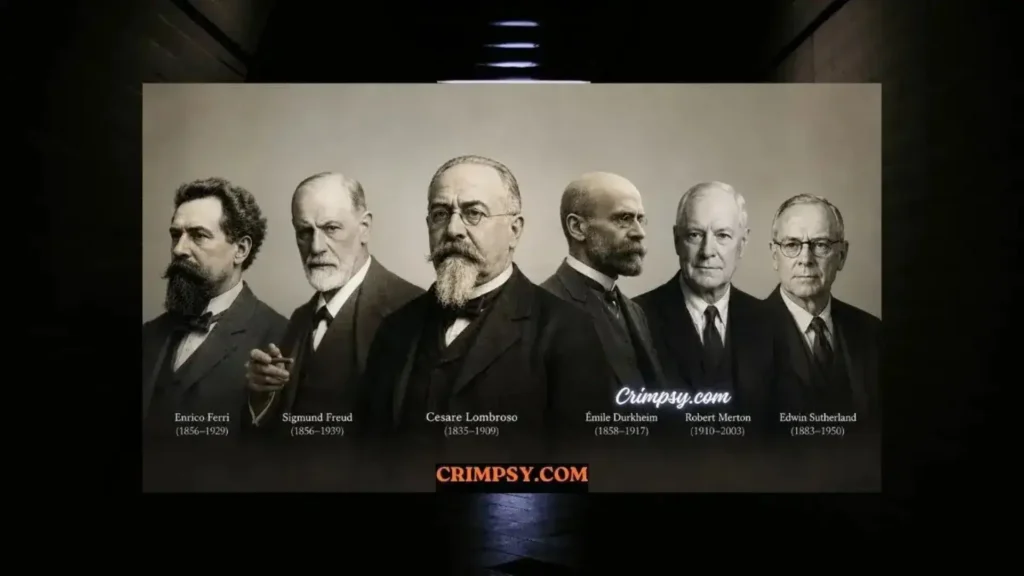
The history of criminology reflects a continuous effort to understand one of the most enduring and complex aspects of human society: crime. From the early scientific ambitions of Cesare Lombroso, who sought to transform the study of crime into an empirical discipline, to the later psychological, sociological, and clinical approaches developed by thinkers such as Sigmund Freud, Émile Durkheim, Robert Merton, Enrico Ferri, Benigno Di Tullio, Edwin Sutherland, Travis Hirschi, Howard Becker, and James Q. Wilson and Richard Herrnstein, criminological thought has evolved into a rich and multidisciplinary field.
Each of these scholars contributed a distinct perspective that challenged previous assumptions and expanded the boundaries of understanding criminal behavior. Some emphasized biological influences, others focused on unconscious motives, social inequality, learned behavior, weakened social bonds, or the interaction between individual and environmental conditions. While many early theories have been revised, criticized, or refined over time, their intellectual contributions remain foundational to contemporary criminology.
Today, criminology recognizes that crime cannot always be explained through a single universal cause. In many cases, criminal behavior emerges through the interaction of multiple biological, psychological, social, economic, and cultural influences. However, criminological research also acknowledges that under certain circumstances, a dominant factor—such as severe psychological disturbance, extreme social deprivation, ideological commitment, or specific environmental conditions—may play a decisive role in the emergence of criminal conduct. The enduring value of these pioneering thinkers lies not only in the specific theories they proposed, but in their collective effort to transform the study of crime into a dynamic scientific discipline capable of explaining both the complexity and diversity of criminal behavior across different contexts and historical periods.
These thinkers and their theories illustrate the diverse approaches within criminology that help us understand the causes of crime. By exploring biological, psychological, and social theories, readers gain a comprehensive view of how criminal behavior develops, offering insights into the motives and conditions that contribute to criminal actions.